Salamander
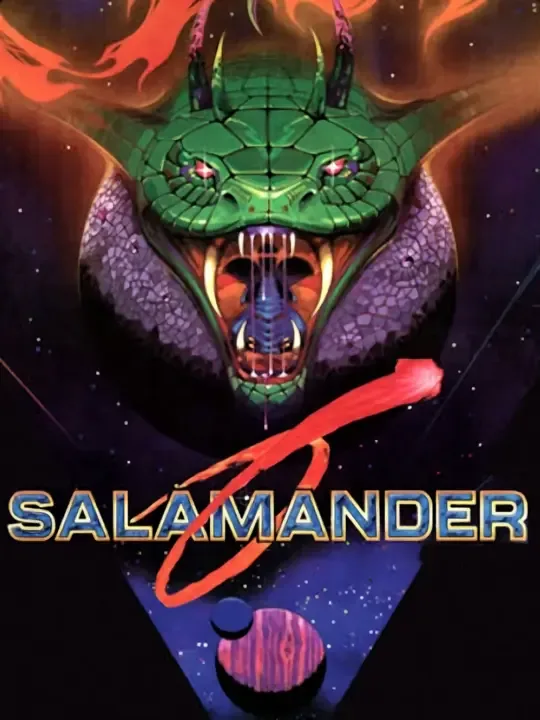
Salamander is a scrolling shooter arcade game released by Konami as a spin-off to Gradius. It introduced a simplified power-up system, two-player cooperative gameplay and both horizontally and vertically scrolling stages. Some of these would later become the norm for future Gradius games.
SCREENSHOTS
HISTORY
Salamander, released as Life Force in North America and in the Japanese arcade re-release, is a 1986 scrolling shooter video game developed and published by Konami for arcades. A spin-off of the Gradius series, Salamander introduced a simplified power-up system, two-player cooperative gameplay and both horizontally and vertically scrolling stages. Some of these later became normal for future Gradius games. In Japanese, the title is written using ateji, which are kanji used for spelling foreign words that has been supplanted in everyday use by katakana. Contra, another game by Konami was also given this treatment, with its title written in Japanese as 魂斗羅 (kontora).
Salamander was followed with a sequel in 1996 titled Salamander 2, with M2 developing another sequel, Salamander III, for Konami's Gradius Origins collection on August 7, 2025.
On April 23, 2026, Konami Arcade Games held the Salamander Lottery, a lottery sale to commemorate the series' 40th anniversary. The lottery sale offered a chance to win Salamander items featuring numerous original illustrations, as well as special postcards as bonus gifts.
Gameplay
The first player controls Vic Viper and the second player takes the reins of debuting spacecraft Lord British, which is sometimes referred to as "Road British" due to the ambiguity of Japanese-to-English romanization. The game features six stages which alter between horizontal and vertical scrolling.
Players are allowed to continue from where they leave upon death instead of being returned to a predefined checkpoint as per Gradius tradition. There are no continues in single player mode, and two in the two-player mode. The number of continues can be changed through DIP switches. The player gains power-ups by picking up capsules left behind by certain enemies, as opposed to the selection bar used in other Gradius games. However, the Japanese version of Life Force keeps the selection bar.
Many of the power-ups can be combined. For example, an option fires a second (or third) salvo of missiles or ripple/plutonic lasers if these power-ups have been attained. The ripple and laser, however, are mutually exclusive. The only power-up that can survive the ship's destruction is the options (called "multiples" in the English release), they followed the exact flight path of the player's ship and fired when they did, but were otherwise invulnerable. Upon the ship's destruction, the options float in space for a brief time before disappearing; the new ship can grab and retain them.
Development
The arcade version of the game was released under its original title in Japan and Europe, and as Life Force in North America. The Japanese and European versions are nearly identical, but the American version changes the game's plot by adding an opening text that establishes the game to be set inside a giant alien life-form which is infected by a strain of bacteria. Stages that feature starfield backgrounds were changed to the web background from Stage 1 to maintain consistency with the organic setting of the plot. The power-ups are also given different names, with the "Speed-Up" becoming "Hyper Speed", the "Missile" becoming the "Destruct Missile", the "Ripple Laser" becoming the "Pulse Laser" and "Force Field" becoming the "Shield". Narration is added to the beginning of each stage, detailing the area of the alien's body which the player is currently inhabiting such as "Enter stomach muscle zone" or "Bio-mechanical brain attack".
Konami later released an enhanced version of Salamander in Japan in 1987 bearing the American title of Life Force which further fleshes out the organic motif. All of the backgrounds and mechanical enemies are completely redrawn and given organic appearances. The power-up system was also modified, with the Japanese Life Force using the same power-up gauge as the original Gradius. Some music tracks have been completely changed for this release and the power-up gauge is arranged differently for both players.
Ports
Ocean Software, on their Imagine label, released licensed versions of Salamander for computer systems by Spectrum, Commodore and Amstrad in 1988. The Spectrum and Amstrad versions were generally criticized, but the Commodore 64 version was highly praised by the critics of the day, particularly Zzap!64. Though missing two of the six stages, the simultaneous two player mode and gameplay being much easier than its arcade counterpart, the Commodore port is generally considered to be one of the best arcade conversions on this system.
Salamander was ported to the Family Computer in Japan in 1987. Instead of being a direct port of Salamander, elements were taken from the original Salamander and the Japanese Life Force re-release, and some elements, such as levels and bosses, were removed to make way for new content. Most of the background graphics and enemy sprites from Salamander are used in favor of those used in Life Force, though the Gradius-style power bar is used in place of the original instant pick-up system. In 1988, North America received a port as well for the Nintendo Entertainment System. The NES version is practically identical to its Famicom equivalent, other than not having the multiple endings, having two option power ups instead of three, and being titled Life Force. The North America version was later re-released for the Virtual Console on February 16, 2009 for the Wii, on January 23, 2014 for the Nintendo 3DS and August 21, 2014 for the Wii U. The European version is titled Life Force: Salamander on its cover and was released on November 22, 1989. The NES version makes use of the Konami Code, which increases the number of lives from three to 30. The first two levels of Life Force were profiled in the second issue of Nintendo Power, issued in 1988. Several issues later the entire game was re-profiled.
The MSX port of Salamander (沙羅曼蛇, Saramanda) is significantly different from the original and any other ports. New to this port is a graphical introduction that introduces human pilots for each ship, as well as names for each stage. The levels are notably longer than the arcade original, and the player is forced to start from a pre-defined checkpoint upon death of either pilot, instead of starting where he left off. After level two, the player can choose the order of the next three stages. In addition, the player can collect "E" capsules by destroying certain enemies. Collecting fifteen will permanently upgrade one of the available weapons on the power-up bar. Some weapons allow the player ships to merge, one player controlling movements and the second player controlling weapons. Instead of the Vic Viper and the Lord British Space Destroyer, the ships are known as the Sabel Tiger and the Thrasher; piloted by human characters named Iggy Rock and Zowie Scott. The story takes place in the year 6709 A.D and has 2 different endings. The MSX version was re-released for the Wii's Virtual Console in Japan on January 12, 2010. It was later released for the Wii U's Virtual Console on July 20, 2016. They were also made available for the Project EGG on Windows Store on May 19, 2015.
A version for the PC Engine was released on December 6, 1991. Based on the arcade version of Salamander, changes on this port include starting from a pre-defined checkpoint upon death in 1 Player mode, faster enemy animations, and improved music. In Japan, the PC Engine version was re-released for the Wii's Virtual Console on September 11, 2007, for PlayStation Network on July 21, 2010 and for the Wii U's Virtual Console on October 22, 2014, and also for the Project EGG con Windows Store on March 3, 2014. It was released in North America on November 16, 2017 for the Wii U's Virtual Console. The PC version is on the TurboGrafx-16 Mini released in 2020 and is the sole title from the compilation that is excluded from the Japanese model while being included in the North American and European ones.…
STORY
The water planet of Latis, a sparkling jewel in the depths of space.
There, a prophecy of fire has been passed down across countless generations.
A thousand light years away, a huge dragon will be born in a sea of flame.
When it awakens, it will engulf heaven and earth in darkness, shattering the light for all time.
The star cluster of Bacterian has continued its conquest of space with its vast forces. Now it has invaded the planet Latis with its Salamander Force.
The armies of Latis are helpless against the intense onslaught of the Salamander Force.
The prince of Latis threw himself into battle, piloting the super-dimensional fighter Lord British, named after himself. Coming back sorely wounded, he called for help from Gradius, the planet that had once defeated Bacterian's forces.
Upon receiving the distress call, one brave Gradius fighter joined Lord British and set off for the immensely powerful Salamander Force's home planet.
Super-dimensional fighter Vic Viper, prepare for takeoff!
1CC RUNS
One-credit clears we point to as the benchmark for this game.