Defender
Defender is an arcade video game developed released by Williams Electronics in 1980. A shooting game featuring two-dimensional (2D) graphics, the game is set on a fictional planet where the player must defeat waves of invading aliens while protecting astronauts. Development was led by Eugene Jarvis, a pinball programmer at Williams; Defender was Jarvis's first video game project, and drew inspiration from Space Invaders and Asteroids. Williams planned to display the game at the Amusement & Music Operators Association (AMOA) trade show, though development delays resulted in the team working on the game up until the show started. Defender was commercially successful, selling over 55,000 units to become the company's best selling arcade game. Praise among critics focused on the game's audio-visuals and gameplay. It is frequently listed as one of Jarvis's best contributions to the video game industry, as well as one of the most difficult video games. Defender was ported to numerous platforms, inspired the development of other games, and was followed by sequels and many imitations.
SCREENSHOTS
PHYSICAL
HISTORY
Defender is a 1981 horizontally scrolling shooter video game developed and published by Williams Electronics for arcades. It was released in Japan by Taito. It is set on an unnamed planet where the player must defeat waves of invading aliens while protecting astronauts. Development was led by Eugene Jarvis, a pinball programmer at Williams; Defender was Jarvis's first video game project and drew inspiration from Space Invaders and Asteroids. Defender was demonstrated in late 1980 and was released in March 1981.
Defender was one of the most important titles of the golden age of arcade video games, selling over 55,000 units to become the company's best-selling game and one of the highest-grossing arcade games ever. Praise among critics focused on the game's audio-visuals and gameplay. It is frequently listed as one of Jarvis's best contributions to the video game industry and one of the most difficult video games. Though not the first game to scroll horizontally, it created the genre of horizontal scrolling shoot 'em ups. It inspired the development of other games and was followed by sequels and many imitations.
Ports were developed for contemporary game systems, most of them by either Atari, Inc. or its software label for non-Atari platforms, Atarisoft. The 1982 Atari 2600 version was one of the best-selling games for the system and sold over 3 million cartridges.
Gameplay
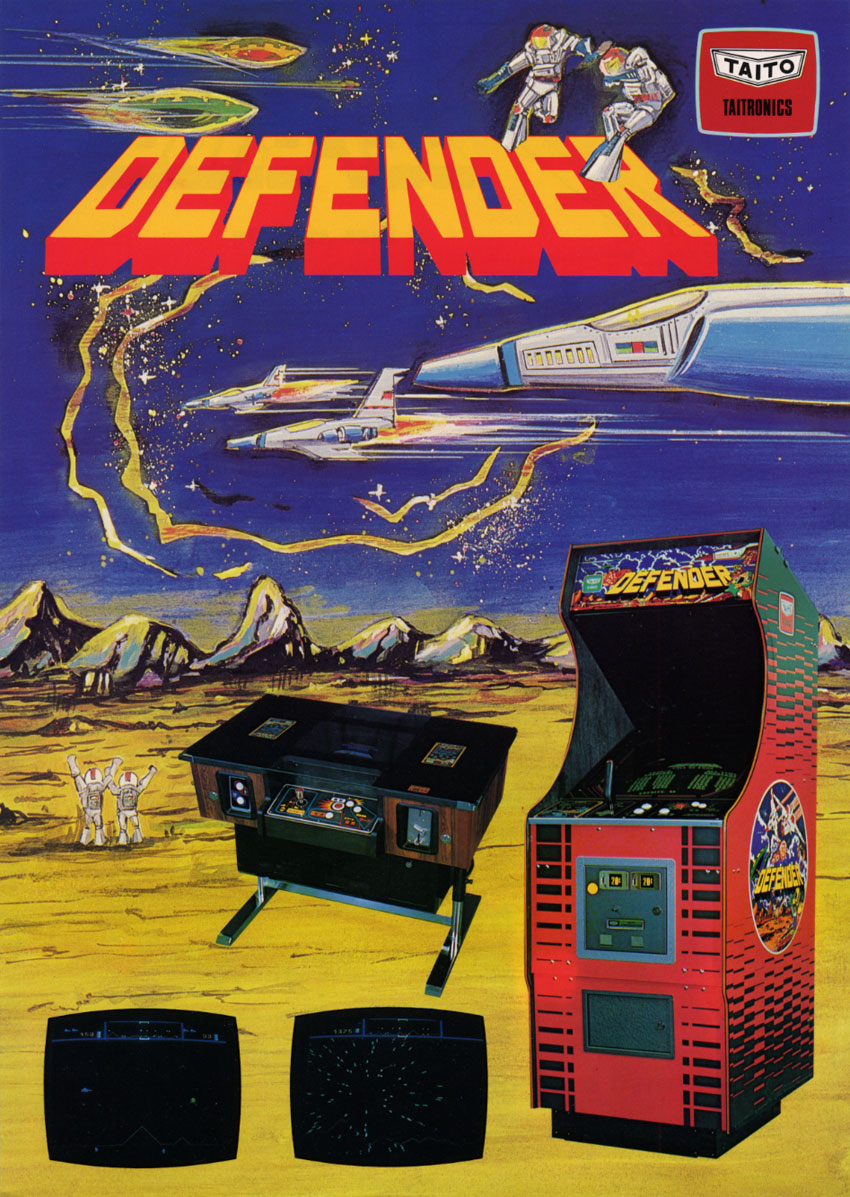
Defender is a side-view, horizontally scrolling shooter set on the surface of an unnamed planet. The player controls a spaceship flying either to the left or right. A joystick controls the ship's elevation, and five buttons control its horizontal direction and weapons. The player starts with three "smart bombs", which destroy all visible enemies. As a last resort, the "hyperspace" button works as in Asteroids: the player's ship reappears in a random—possibly unsafe—location. Players are allotted three ships at the start of the game; another ship and smart bomb are awarded every 10,000 points (adjustable per machine). Two players can alternate turns.
The object is to destroy all alien invaders, while protecting astronauts on the landscape from abduction. Landers pick up humans and attempt to carry them to the top of the screen at which point they turn into fast-moving mutants. A captured human can be freed by shooting the lander, then catching the human before it falls to its death, and dropping it off on the ground.
Defeating the aliens allows the player to progress to the next level. Failing to protect the astronauts, however, causes the planet to explode and the level to become populated with mutants. Surviving the waves of mutants results in the restoration of the planet. A ship is lost if it is hit by an enemy or its projectiles, or if a hyperspace jump goes wrong (as they randomly do). After exhausting all ships, the game ends.
Development
Defender was Williams Electronics' first attempt at developing an original video game; the company's earlier game was a Pong clone. The popularity of coin-operated video games in 1979 spurred it to expand beyond pinball games. The company chose Eugene Jarvis, who had a successful record of Williams pinball games, to head development. Additionally, the release of Taito's Space Invaders in 1978 inspired Jarvis to pursue arcade game development. Larry DeMar, Sam Dicker, and Paul Dussault assisted Jarvis.
Development began around October 1979. The team first determined the specifications of the game's hardware. They aimed to portray Williams games as technologically advanced and included more capabilities than the game required. At the time, Williams had a small staff and its management was unfamiliar with the technology used for its electronic games. As a result, the developers were afforded a large amount of creative freedom. They used a Motorola EXORciser computer to developer the game's program.
Early designs and conception
Initially, Jarvis spent 3–4 months developing color variations of Space Invaders and Atari, Inc.'s Asteroids. Space was a popular setting for video games at the time, and Jarvis felt the abstract setting would help obscure simple graphics. First inspired by Space Invaders, he created a prototype with similar gameplay that included new mechanics. After spending a few weeks with the design, however, the team felt it was dull and abandoned the idea. Development then shifted to emulating Asteroids, which displays vector graphics on a special monitor, and the team experimented with recreating the game with pixel graphics. They abandoned this design as well, deeming it a poor recreation and visually unappealing.
Believing the first attempts to be too derivative, the developers held brainstorming sessions. During a session, they agreed that one of Asteroids's favorable elements was its wraparound screen effect. They felt that allowing the player to fly a ship off the screen would be exciting and decided to create a game world larger than the screen displayed. The game's environment was made wider than the screen and scrolled horizontally. Expanding on the idea, they envisioned Space Invaders' design rotated 90 degrees to have the ship move up and down while flying horizontally. Large asteroids, an element from Asteroids, were added to the game world but later removed. Jarvis intended the screen to scroll only from left to right; fellow Williams employee Steve Ritchie, however, convinced him the game should be able to scroll in either direction.
After six months of development, the team considered the progress insufficient. They examined other games and concluded that survival was a necessary component. The team devised enemies to present a threat, the first of which was the "Lander". Jarvis enjoyed violent, action entertainment, and he wanted to include those elements but felt the action should have a reasonable objective. Inspired by the 1960s television show The Defenders, Jarvis titled the game Defender, reasoning that the title helped justify the violence. He added astronauts to expand on the space theme and give the player something to defend while shooting enemies. Jarvis believed the combination of offensive and defensive actions created a "rich tactical and strategic experience" that forced the player to frequently evaluate the situation's priorities. He further noted that the added complexity made the gameplay less monotonous, which differentiated it from other games that solely rely on a relentless battle that eventually kills the player character.
The element of flying over a planetscape was added after a brainstorming session between Jarvis and Ritchie. The landscape is depicted as a line only a pixel wide, primarily because the hardware was not powerful enough to generate anything more detailed. The background stars' movements were made slower than the ship in order to create a sense of depth.…
STORY
In the future an alien race known as the "Manti" attacks Earth with their relatives the Irata. Manti have been seen kidnapping humans for unknown reasons but, it is known that after a Manti grabs a human that they become more powerful. If the Manti successfully create the ultimate Mutant Army, then Earth won't stand a chance. Star-Fighters have been dispatched to Defend mankind from the enemy.
1CC RUNS
One-credit clears we point to as the benchmark for this game.
GAMEPLAY VIDEO
SCORES
ACHIEVEMENTS 2 sets
Tracked by RetroAchievements and earned in an emulator that reports to it. A game tracked on more than one machine gets a set for each, because they are different lists earned on different hardware.
RELEASES 12 systems
PHYSICAL RELEASES 1 box