Time Pilot
Time Pilot is a multi-directional scrolling shooter and free-roaming aerial combat arcade game designed by Yoshiki Okamoto, released by Konami in 1982, and distributed in the United States by Centuri. Debuting in the golden age of video arcade games, it is a time travel themed game that allowed the player's plane to freely move across open air space that can scroll indefinitely in all directions. The Killer List of Videogames included Time Pilot in its list of top 100 arcade games of all time. The player assumes the role of a pilot of a futuristic fighter jet, trying to rescue fellow pilots trapped in different time eras. The player must fight off hordes of enemy craft and defeat the mother ship (or "boss") present in every level. The background moves in the opposite direction to the player's plane, rather than the other way around; the player's plane always remains in the center.
SCREENSHOTS
PHYSICAL
HISTORY
Time Pilot is a 1982 multidirectional shooter video game developed and published by Konami for arcades. It was distributed in the United States by Centuri and by Atari in PAL regions. While engaging in aerial combat, the player-controlled jet flies across open airspace that scrolls indefinitely in all directions. Each level is themed to a different time period. Home ports for the Atari 2600, MSX, and ColecoVision were released in 1983 respectively by Konami and Coleco.
A top-down sequel, Time Pilot '84, was released in arcades in 1984. It eliminated the time-travel motif and instead took place over a futuristic landscape.
Gameplay
Players assume the role of a pilot of a futuristic fighter jet trying to rescue fellow pilots trapped in different time eras. The player's jet remains in the center of the screen at all times, and the eight-direction joystick causes their jet to rotate to face in that direction, causing the screen to scroll in that direction to present forward motion.
In each level, players battle many enemy aircraft and the occasional stronger aircraft. After a fixed number of these aircraft are destroyed, as displayed on a bar at the bottom right of the screen, a mothership appears. Once the mothership is defeated, they move onto the next time period. Parachuting pilots will occasionally appear and award players points if collected.
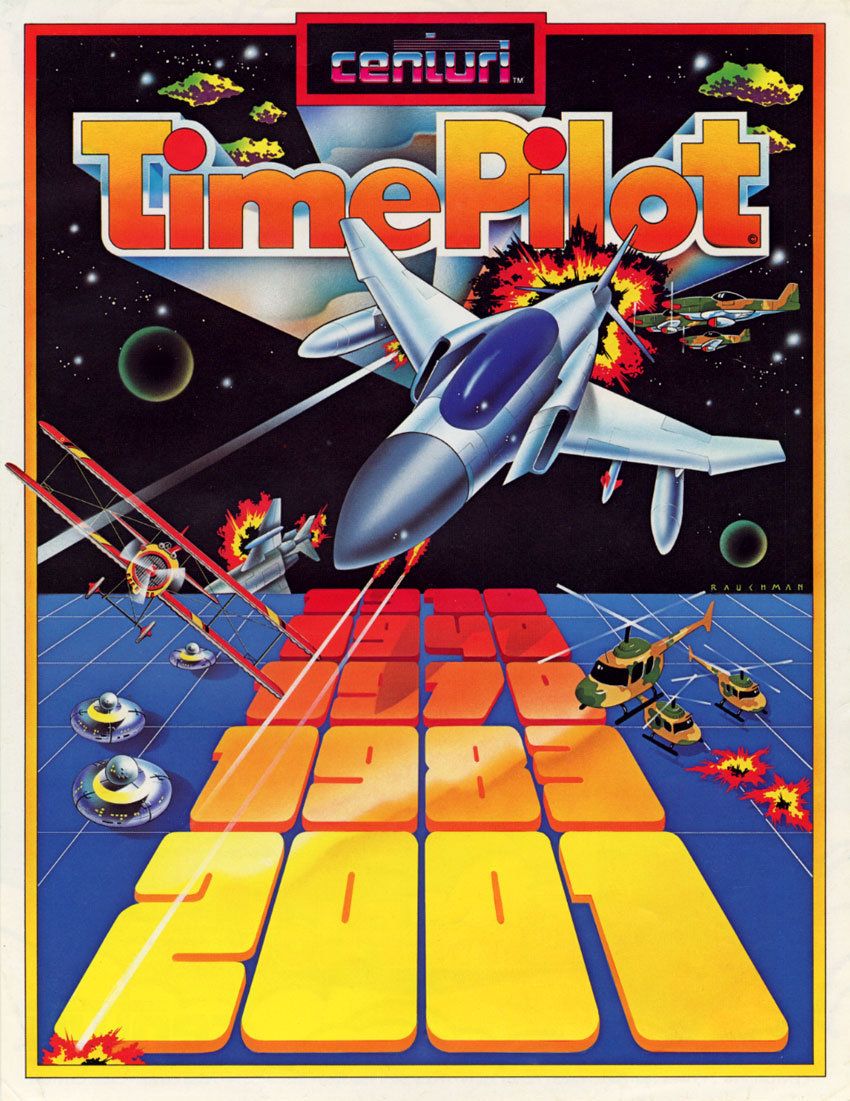
There are five levels: 1910, 1940, 1970, 1982/1983 and 2001. After the fifth level is finished, the game repeats thereafter.
Extra lives are given at 10,000 points, and per 50,000 scored up to 960,000; thereafter, the game goes to "survival of the fittest" mode.
Fighters are destroyed if they collide into bullets, enemy ships, bombs or missiles. Game ends when their last fighter is destroyed.
Development
Designer Yoshiki Okamoto's proposal for Time Pilot was initially rejected by his boss at Konami, who assigned Okamoto to work on a driving game instead. Okamoto secretly gave instructions to his programmer to work on his idea while he pretended to work on a driving game in front of his boss.
Reception
In Japan, the annual Game Machine chart listed Time Pilot as the fifth highest-grossing arcade video game of 1982. Game Machine later listed Time Pilot on their June 1, 1983 issue as being the eighteenth most popular arcade title of the month.
In the United States, the game topped the Play Meter arcade earnings chart in February 1983. The Amusement & Music Operators Association (AMOA) later listed it among the thirteen highest-earning arcade games of 1983.
Computer and Video Games magazine gave the arcade game a generally favorable review upon release.
Legacy
Re-releases
A Time Pilot '95 bonus game is available in Ganbare Goemon Kirakira Douchuu: Boku ga Dancer ni Natta Wake. for the Super Famicom. The arcade version was released on the PlayStation through Konami Arcade Classics in 1999. It was also re-released for the Xbox 360 as part of Xbox Live Arcade on August 30, 2006, Nintendo DS as part of Konami Classics Series: Arcade Hits and i-mode mobile phones in Japan, 2004.
The game was ported to the Game Boy Advance as part of Konami Collector's Series: Arcade Advanced on March 18, 2002. This version includes a hidden sixth era, 1,000,000 BC, with pterodactyl enemies.
Hamster Corporation released the arcade version for the PlayStation 2 as part of the Oretachi Gēsen Zoku series in 2005 in Japan. The company also released the game as part of their Arcade Archives series for the Nintendo Switch and PlayStation 4 in 2021.
Clones
Fury is a 1983 clone from Computer Shack for the TRS-80 Color Computer. Two clones, both called Space Pilot but otherwise unrelated, were released in 1984 and 1986: from Kingsoft for the Commodore 16 and Commodore 64 and Superior Software for the BBC Micro. Vector Pilot is a 2011 hobbyist-written clone for the Vectrex console.
STORY
This game has the player travel through five time periods, rescuing stranded fellow pilots. The player must fight off droves of enemy craft while picking up parachuting friendly pilots. Once 56 enemy craft are defeated, initially 25 on the MSX platform and increasing by 5 after each game cycle (finishing the last battle against the UFOs), the player must defeat the mothership for the time period. Once she is destroyed, any remaining enemy craft are also eliminated and the player time-travels to the next level. All the levels have a blue sky and clouds as the background except the last level, which has space and asteroids instead. The specific eras visited, the common enemies, and the motherships are the following:
1910: biplanes and a blimp
1940: WWII monoplanes and a B-25
1970: helicopters and a large, blue CH-46
1982 (Konami version)/1983 (Centuri version): jets and a B-52
2001: UFOs
The mothership is destroyed with seven direct hits. Once all the eras have been visited, the levels start over again but are harder and faster. The Game Boy Advance version of Time Pilot in Konami Arcade Classics includes a hidden sixth era, 1,000,000 BC, where the player must destroy vicious pterodactyls in order to return to the early 20th century.
1CC RUNS
One-credit clears we point to as the benchmark for this game.
GAMEPLAY VIDEO
STORES
Prices are cached from each storefront and may be out of date. Last checked 24 Sept 2026.
SCORES
ACHIEVEMENTS 2 sets
Tracked by RetroAchievements and earned in an emulator that reports to it. A game tracked on more than one machine gets a set for each, because they are different lists earned on different hardware.
RELEASES 8 systems
PHYSICAL RELEASES 1 box