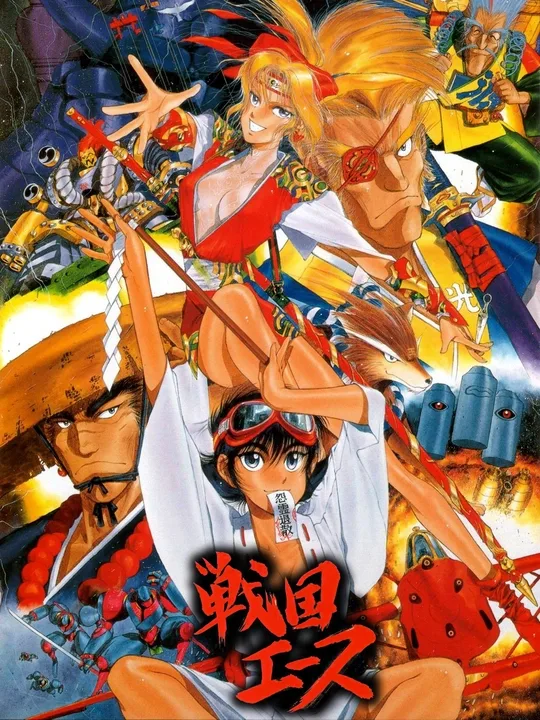
Sengoku Ace
Sengoku Ace, fully titled Sengoku Ace: Tengai Episode I and also known as Samurai Aces in the English version, is a vertically-scrolling shoot 'em up video game originally released in the arcades by Psikyo in 1993. The first game by Psikyo, Sengoku Ace was designed by Shin Nakamura, the creator of Aero Fighters (Sonic Wings) and the company's founder. The game features 21 endings, different for various characters and 2-player pairings.
SCREENSHOTS
HISTORY
Sengoku Ace (JP: 戦国エース, known as Samurai Aces internationally), published in 1993, is a vertical shooting game and the first game developed by Psikyo. It was followed by two sequels, Sengoku Blade and Sengoku Cannon. The game was ported to the PlayStation 2 in 2004 and to the Switch in 2018 as part of the Psikyo Shooting Collection vol. 2 and Psikyo Shooting Stars Bravo, respectively, and is available to play on Android with in-app purchases as Samurai Aces: Tengai Episode1 and SAMURAI ACES classic.
The game takes place in a kitchen sink fantasy setting loosely modelled on the Sengoku period alongside steam engines and biplanes. Both enemies and main characters contain parodic references to Buddhism and Shinto, as well as ninjas and samurai. Every character has their own story which plays out in dialogue between the stages and an ending cutscene, and if the game is played two-player, both player’s charactes will interact, for a total of 22 endings.
For replay videos, visit the Video Index.
Development
After developing Aero Fighters in 1992, main desiger Shinsuke Nakamura left Video System to found Psikyo with some other former Video System staff. They wanted to make games that were distinct from games by other developers, but Sengoku Aces was similar to Aero Fighters because “at that time, we couldn’t think of anything else to make.” The characters were designed by Hirofumi Nakamura, an illustrator and doujin mangaka who Yamada described as having “really passionate fans.” When designing the game, the developers said they tried to ensure that “deaths feel fair” and made sure nothing shares the same colour as the enemy bullets.
Gameplay Overview
Sengoku Ace is vertically scrolling shooter with 8-way movement and two buttons. There are four levels of power-up: at full power, the shot will eventually decay back to the third level as long as you continue shooting.
Each game loop consists of seven stages, with the first three stages being randomly chosen from a possible four. After defeating the last boss the player automatically enters a second loop. The second loop features remixed enemy and bullet patterns which are much more difficult.
There is one extend at 400,000.
Controls
A (Press): Fires the main weapon and, after collecting two power-ups, a subweapon
A (Hold): Fires a charge shot. Charge shots are unique to every character.
B: Uses a bomb. Bombs are unique to every character
Difficulties
The arcade version has four difficulties, accessible via changing the dip-switches. The modes are Easy, Normal, Hard and Hardest. On the Easy difficulty, only large enemies shoot and bullets are slowed slightly. On the Hard difficulty, bullets are faster and enemies shoot more aggressively. The Hardest difficulty adds a lot more enemies to each stage and enemies shoot more aggressively, but bullets are slowed down considerably, changing the game substantially.
The number of lives per credit and the ‘price’ of an extend can also be adjusted via dip-switches, from 1-6 lives per credit (3 at default) and an extend at 400,000 (at default) or 600,000.
Characters
Jane
Aine
Tengai
Koyori
Kenoumaru
Gennai
Rank
Rank scales with your power-up level. As you collect more power-ups, the speed of opposing bullets will increase. At maximum power the bullets are much faster than at third level power, and at minimum power they are quite slow. You can control rank by avoiding power-ups. If you keep shooting and dont collect any more powerups you will eventually power down and rank will also decrease.
As many difficult sections can be trivialized by speedkilling enemies before they can shoot, managing rank is often not safer. When managing rank is safer will depend on the character played.
Items
Power-up: This increases your current level of power, to a maximum of 4. After shooting for a while at maximum power without picking up another power-up, your power will decrease one level. At maximum power, picking up an additional power-up awards 2000 points.
Bomb: Increases your bomb stock by one. You can hold seven bombs at once; picking up an 8th bomb awards an enormous 10,000 points.
Coin: Coins can be uncovered by destroying certain buildings or enemies. Each coin collected awards an unimpressive 200 points.
Scoring
When to destroy the first train.
Scoring in Sengoku Ace is fairly simple. Destroying enemies and collecting coins award points. Most bosses have several parts which award extra points when destroyed separately, and a handful of bosses have respawning enemy waves or destructible shots, letting them be milked for score. For more information, see Sengoku Ace/Strategy.
At full power, additional power-ups award 2000 points, and at the maximum bomb stock of 7 bombs, additional bombs add 10,000 points. The 10k from each additional bomb makes up a large part of the difference among the highest scores, so reaching a high score requires an almost No Miss No Bomb of the game. As the player’s ship drops a power-up when destroyed, most superplays begin by suiciding twice at the start of the game for an extra 4,000 points.
Each building in the three rows of houses before the Town stage boss has a random chance to drop a bomb or a power-up, which can contribute a lot to your score. It’s better to prioritize destroying houses over collecting the coins, which add very little to your score; one extra bomb is worth more than all the coins in both loops of the game. Every other stage awards one guaranteed bomb per stage, carried by an enemy or midboss.
It is possible to spawn an extra train in the Town stage. In order to do this, the destruction of the first train has to be delayed; the first cart can be destroyed at any time, but when you destroy the second cart, the train will stop moving. If you stop the first train very close to the bottom of the screen, the second train will come down the track before the tank appears. If you also stop this cart very close to the bottom of the screen, a third train will appear during the midboss. Getting the third train requires tight timing. Each train cart is worth 1,000 points, so the extra trains adds a substantial 2,000 in total, and 4,000 if you can do it in both loops.
There are two stages which give a random boss: the Cloud Sea stage and the Final stage. In the Cloud Sea stage the boss can either be Fujin (right) or Raijin (left). While they award the same number of points when defeated, Raijin drops up to five power-ups, for a total of 10,000 possible extra points, while Fujin drops nothing. On the Final stage the boss can either be a demon or, very rarely, a cat wearing a big straw hat. While the cat awards 10,000 more points than the demon, the demon creates two destructible vajra which award 10,000 each, making the demon worth 10,000 more.
Japanese replays of the game generally note how many extra bombs they collect by writing 10k×n (1万×n), how many times Raijin spawned by writing Raijin×n (雷神×n), and whether or not they got the bonus train in each loop (eg. 列車なし, ‘No Train’).
Strategy
See Sengoku Ace/Strategy for level walkthroughs and scoring techniques!
Ports
PlayStation 2
In Japan, Sengoku Ace was ported to the PlayStation 2 by Taito and released on December 2nd, 2004, as part of the Psikyo Shooting Collection vol. 2, which also included Sengoku Blade. The games were localized in the west separately, as Samurai Aces and Tengai respectively, by 505 Games, an Italian publisher who at the time mostly brought over Japanese curiosities like Demolition Girl.
The port allows the player to disable the random stages and instead choose which stages to play. It also features a stage select for practicing, a tate mode, and 7 difficulty modes: 4 it shares with the arcade release (Easy, Normal, Hard, VeryHard) which play the same way, and 3 original difficulties which are even easier (Monkey, Child, and VeryEasy). On Monkey, only large enemies shoot bullets, and bullets move very slowly.
The resolution of the port is slightly stretched horizontally, and it plays slightly slower than the arcade version. (ED: verify this isn’t an emulator issue)
Android
Two of the Android versions (both named Samurai Aces: Tengai Episode1) were ported by the Korea-based company SEC Ent. Inc. In the first version released on June 21st, 2017, only Jane is unlocked by default. The remaining characters are unlocked by meeting certain conditions, for example, Tengai is unlocked by collecting 5 “Login Streak Rewards” from daily login bonuses. Bombs and 'magnets' which attract coins can be purchased in the ingame store for real money. The loading screen features tips, such as “Make sure you buy bombs before entering the battlefield.”
The game has been changed substantially; bullets are considerably slower, enemies have significantly less health, and most enemies drop gold which the player absorbs and can be used as ingame currency. Some levels feature significantly remixed enemy placements. The charge shot and the bomb can be activated by buttons or through gesture controls; the charge shot is on a very long cooldown. Power-ups no longer raise your shot power when collected; instead, multiple have to be collected to advance one power level. The screen scrolls much faster in certain parts, causing the Lake boss to play very differently. The trains in the Town stage do not stop when destroyed, so the player will always get all three trains. The player can continue after watching an ad.
The newest version, released on August 19th, 2020, hews closer to the original game. Levels aren't remixed and scroll normally, and all characters are unlocked by default. The ship autofires automatically and you can charge shot while autofiring without interrupting your regular shot. 'Diamonds', the ingame currency, can be earned by watching advertisements, at a rate of 30 gems per advertisement; this can be done every 30 minutes, although you’re welcome to watch ads for no reward whenever you like. There are achievements, such as “supergenius dog Kenohmaru”, which awards 500xp for clearing a game with Kenoumaru, or “monk power fully open”, which awards 2,000xp for reaching maximum power. There’s an online leaderboard which is separated by difficulty. The current highest score for Normal is 840,902, and there are no scores recorded for Very Hard.
References & Contributions
Primary info provided by laurabuzz
Some info adapted from ACSeraph's "1-ALL Flight Manual"
↑ Videogame Music Database. Retrieved 11.09.20.
↑ 2.0 2.1 "Samurai Aces" at Mobygames. Retrieved 11.09.20.
↑ 3.0 3.1 3.2 3.3 "Two 1997 Developer Interviews", trans. "blackoak". Retrieved 11.09.20.
↑ 4.0 4.1 Index of games by Taito Corporation at Mobygames. Retrieved 11.09.20.
↑ 5.0 5.1 Index of games by 505 Games at Mobygames. Retrieved 11.09.20.
↑ 6.0 6.1 Google Play page “Samurai Aces: Tengai Episode1”
↑ Google Play page “SAMURAI ACES classic”
↑ 8.0 8.1 Google Play page “Samurai Aces: Tengai Episode1" but a different one.
↑ "Samurai Aces for Nintendo Switch" at Nintendo.com. Retrieved 11.09.20.
↑ "Psikyo Shooting Stars Bravo" at Nintendo.com. Retrieved 11.09.20.
↑ "Psikyo" at Mobygames. Retrieved 11.09.20.
↑ VGMuseum page for Samurai Aces. Retrieved 11.09.20.
↑ "Shinsuke Nakamura" at Mobygames. Retrieved 11.09.20.
↑ "Hirofumi Nakamura" at the Japanese wikipedia. Retrieved 11.09.20.
STORY
The science fantasy story of Sengoku Ace resolves around the six Feudal Japan (Sengoku period) characters sent on a mission to stop an evil cult and rescue the shogun's kidnapped daughter, princess Tsukihime (Moon Princess), before she can be used as a sacrifice to resurrect their demon god.
1CC RUNS
One-credit clears we point to as the benchmark for this game.