Radiant Silvergun
Unlike in most other shoot 'em ups, there are no power-ups. All weapons are available from the start. Weapons can 'level up', however, becoming more powerful as the player uses them to score points. There are a selection of 7 weapons that can be used at any given time: The game is designed so that there is almost always a 'right' weapon for any situation. The bosses in the game are designed so that they have multiple 'sections' which, if all destroyed before the 'core' of the boss, will award the players with point bonuses. Being able to apply the right weapons on any different boss is key to obtaining these bonuses. For example, a boss may have two sections located on either side of the screen. You could immediately go up to one and begin shooting it with a vulcan, or you could hover in the centre and hit both at the same time with the side bombs. This would increase your chance of obtaining the bonus before the time limit runs out and the boss self-destructs. The game rewards players for "chaining" enemies of just one of three colors, red, blue, or yellow. Whenever the player kills three enemies that are of the same color, who can obtain a points bonus. This also facilitates faster upgrading of weapons.
SCREENSHOTS
PHYSICAL
HISTORY
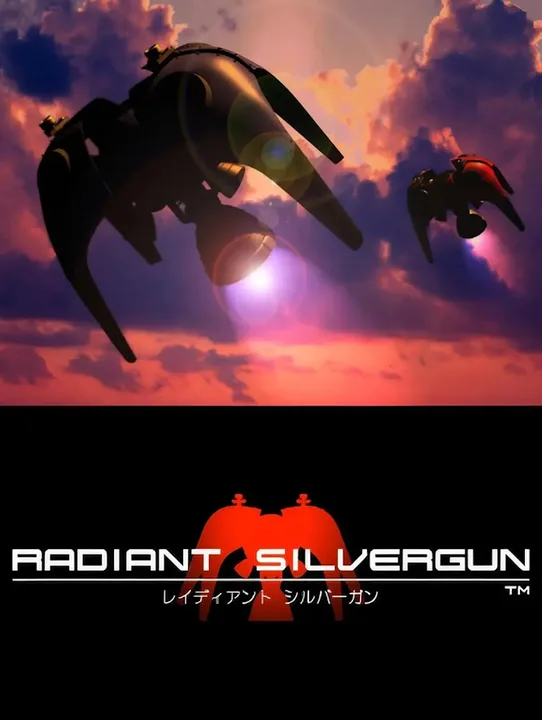
Radiant Silvergun (JP:レイディアント シルバーガン) is the first shooting game developed by Treasure in the year 1998. It is a vertical shooting game. The game features a futuristic, apocalyptic setting, and a single playable ship, the Silvergun. The scoring mechanic involves destroying groups of three enemies (refered onwards as "chaining") of certain specific colors, Red, Blue and Yellow, with each chain of 3 increasing score progressively. Shooting an enemy of another color breaks the chain and its bonus points. Somewhat unique for the genre, Radiant Silvergun features no traditional collectible power-ups, instead relying on score pertaining to one of the game's three main Weapon Types to measure their power and effective range.
Radiant Silvergun was initially developed for the Sega Saturn-adjacent arcade board ST-V, before release in the home console Sega Saturn. It later received ports to the XBOX 360, Nintendo Switch and Windows PC, by Treasure alongside Live Wire. It has a spiritual sequel developed by Treasure, named Ikaruga, conceived as "Project RS-2", featuring radically different gameplay mechanics.
For replay videos, visit the Video Index.
Story
Radiant Silvergun's story is told in a non-linear fashion. The narration, dialogue between the characters and the special cutscenes, including opening and ending FMVs, are missing from the ST-V release of the game, only present in home console versions. These narration and dialogue scenes are crucial for understanding the inner plot of the game, but the arcade version presents a simplified version of the events.
The ST-V board version/arcade version of home versions of Radiant Silvergun contains images with captions explaining the story of the game:
July 2520 A.D.: A robonoid is unearthed from a prehistoric stratum. It is found to be identical to a robonoid manufactured in 2519 A.D.
Nearby, a stone-like object is unearthed, but its purpose cannot be determined from analysis of its composition.
The Research Laboratory of the Global Coalition Forces successfully restores the Robonoid's memory data, but it is lost in a mysterious explosion.
At the same time, an unknown flying object and a stone-like object appear and begin an indiscriminate attack on the human race. Before long, the stone-like object emits a blinding light that annihilates the human race.
One year later... four crew members and a robonoid from the cruise ship Tetra who escaped death by taking in an orbiting satellite stake their survival on a mission to return to Earth.
Gameplay Overview
Radiant Silvergun is a 3-button game, featuring 8-directional movement. Pressing various buttons in tandem will deploy combined weapons. The game has 6 stages which the player tackles in non-linear order, starting with Stage 3 and ending with Stage 1, with most of them further divided into various sub-stages, such as Stage 2D or Stage 6A. Each stage subdivision serves as natural breaking points for chains, and can be known as such by the appearance of the Boss Report screen. The ST-V version/Arcade Mode of home ports lets the player access 5 of the six stages of the game, presenting a choice between Stage 2 and Stage 4 at the end of Stage 3, the game's first stage. The Saturn/Story Mode takes the player through all stages in the game, starting with Stage 3, Stage 2, Stage 4, Stage 5, Stage 6 and ending with Stage 1. The Saturn Mode/Story Mode allows the player to save their ship's progress after a game over, letting the player carry on their Weapon Type levels to a new attempt.
The Silvergun defeating Stage 2A boss, Kotetsu. Bosses explode violently when defeated or self-destructing.
Controls
|| ||
Directional buttons: Move the ship in eight directions. The player cannot influence ship speed in-game.
A Button: Weapon Type A, Vulcan Laser.
A (press): Fires a single red forward shot of Weapon Type A. Good for focused shots.
A (hold): Fires multiples of two red twin shots of Weapon Type A. The higher the weapon's level, the higher the count of shots deployed by volley in multiples of 2.
B Button: Weapon Type B, Homing Shot. Fires two green homing shots. These homing shots will target the nearest enemy, travelling in a circular path. If their target was destroyed, they will redirect course. The homing shots disappear after hitting walls and objects. The higher the weapon's level, the shots become bigger and inflict more damage.
C Button: Weapon Type C, Spread Shot. Fires two blue spread shots in a diagonal angle forward. In contact with enemies, walls and objects, they will explode, forming a damage spread. They can be manually detonated as well. The higher the weapon level, the bigger the damage and the radius of the spread shot explosion.
C (release): Manually detonates Weapon Type C shots. Only three pairs of spread shot can exist in the screen at a time.
In addition to the main Weapon types, Radiant Silvergun also features four different attacks that can be performed by pressing two buttons in tandem (in home console releases, these attack combinations can be bound to other buttons as well). These weapons' firepower and range are associated to their founding Weapon Types:
|| ||
A Button + B Button: Weapon Type A+B, Homing Plasma. Seeks an enemy/object to target within its line of fire (roughly ~90 variable degrees in front of the ship) and fires a homing plasma lightning shot at it. The shot increases in size and damage as time passes touching the same target. Moving away of the initial locked angle will free the weapon and end the damage on target. Can pass through walls. Its damage and angular radius increase with the Weapon Type increases of A and B.
A Button + C Button: Weapon Type A+C, Back-Wide Shot. Fires a back volley of shots as well as a forward single shot volley. Its damage and amount of back fires shot increase with the Weapon Type increases of A and C.
B Button + C Button: Weapon Type B+C, Lock-On Spread. Fires explosive bullets at all targets within weapon's radius. These shots take a while to reach their target location (which may not be the same location as the enemy if it is mobile) and explode in a radius. Can pass through walls and enemies. This is the only weapon that can uncover the game's secret hidden dogs called Merry. Its firing frequency and damage increase with the Weapon Type increases of B and C.
A Button + B Button + C Button: Weapon Type A+B+C, Radiant Sword. Combining all three weapon types lets the player utilize the Radiant Sword. Its initial swipe is determined by the last directional movement inputted by the player. The blade remains targetting the opposite of the last inputted direction (for example, if the player is moving forward, the sword will face backwards). Inflicts continuous damage to targets in contact. Can absorb pink bullets fired by enemies, filling the Hyper Sword Gauge. Its damage increases with the Weapon Type increases of A, B and C.
A+B+C (Full Gauge): Weapon Type A+B+C, Hyper Sword. By pressing the Radiant Sword button when the Hyper Sword Gauge is full (10 pink bullets are enough to fill the gauge), the ship can perform Hyper Sword. Two big blades point towards the forward diagonals, go back and lunge forward, crashing at each other. These blades inflict contact damage to enemies. After crashing at each other, the swords spread shrapnels, which can also damage enemies. While using this attack, the Silvergun is temporarily immune to all contact damage, including that of walls and environmental hazards, serving as this game's version of the Bomb. Its damage increases with the Weapon Type increases of A, B and C. If the player loses a life, the Hyper Sword Gauge resets to default value.
Extends
The player starts with 3 ships by default (2 in stock, 1 in use).Extra ships can be acquired by default on ST-V version in the score thresholds of 1,000,000 points and 5,000,000 points. The player can change the default Extend values in-game before starting a session on the home console realeases. The player can also change the number of starting ships in Options before starting a session in the home console releases, though it depends on the chosen mode of the game.
Difficulty Modes
The ST-V version of the game runs on Normal difficulty. The home console releases of the game have 5 different difficulty settings: Very Easy, Easy, Normal, Hard and Very Hard. Very Easy and Easy feature less enemies, meaning that chain routes differ meaningfully from other versions. Hard and Very Hard modes add more enemies, revenge bullets to some and most enemies, respectively, meaning chain routes also change. The chosen difficulty mode will also alter boss behaviour: most notably, Stage 3D boss (UNDO) arena's pillars vary greatly between difficulty modes: they will spin around on higher difficulties (Hard and Very Hard), destroying the player ship on contact, while in lower difficulties they come in smaller numbers and lack the spinning ability.
Stages
Radiant Silvergun presents a total of 6 stages, each divided into sub-sections discriminated by letters (e.g. 3C, 5A). Your chain does not carry over on each sub-section of a stage, and you can determine a stage has ended when you see the boss tally screen at the end of the every boss fight, followed by the new stage screen, listing the sub-section, current time of events and descent point.
Bosses
WIP
Destroying all parts of the boss in time awards the player a PERFECT destruction bonus and 100,000 points.
Letting the boss survive for too long will triger its own self-destruction, awarding you no points for its destruction, only for the bits you have managed to destroy.
Radiant Silvergun features a total of 22 named bosses (called assailants by the in-game Warning screen), all with distinct visuals and behaviours. As most bosses don't fight alongside enemies, your main ways of attaining points while fighting bosses consist of destroying individual bits of the boss itself, as well as Weapon Bonuses and grazing bonuses. If too much time is taken fighting the boss, it will self-destruct, awarding the player no points for its destruction. The displayed HP of bosses represents the central bit, which ends the fight when destroyed or self-destructing. Therefore, to achieve a PERFECT destruction bonus, the player must destroy all bits of a boss before destroying its central bit. The player receives a Destruction Bonus by manually defeating a boss, which increases depending on the boss' placement in the Stage order (AKA-O, the first boss in the game, grants a Destruction Bonus of 5,000, while other bosses can grant the player an upward of 100,000 bonus points for destruction).
Scoring Mechanics
WIP
There are four ways to score in Radiant Silvergun: destroying enemies, fulfilling Weapon Bonus conditions, finding Merries scattered throughout the stages, and grazing. As weapon damage is tied to score, it is important not to ignore the score mechanics when playing the game, or some bosses will only ever be progressed through by waiting for their self-destruction, awarding the player no points. However, it is beneficial in high-level play to milk points whenever possible, including on bosses that do allow chain progression, such as 5A's SBS 130.
As Red is the most common type of enemy, it is recommended to chain Red enemy trios in order to increase score. An adequately performed Red enemy chain in Stage 5A can award the player with upwards of 5,000,000 points.
The maximum chain is 100,000 points. Each subsequent chain will not be increased, but will reward the player with more 100,000 points.
The Secret Chain can be obtained by defeating any number of Red enemies, a single Blue enemy, then one Yellow enemies, and it rewards the player with 10,000 secret chain points. The next Yellow enemy chain will also reward the player 10,000 points, in increments of 10,000 until max chain value is reached. This chain is the second most optimal, and it sees use as both in high play as both the main chain in some stages of the game as well as a way to capstone a stage that does not end with more Red enemies. An example of a substage where the Secret Chain is quite valuable is Stage 2B, as it features a fixed number of Yellow enemies that can reward the player with Max chain value during the boss fight with the first of the two GOLETS. As Yellow enemies appear less frequently than Red enemies, not every opportunity of a Secret chain should be taken.
Secrets
As you find more dogs, the number of dogs in this screen increases, and doing so changes the title below (Sega Saturn version only).
Scattered through the game are small dogs known as "Merry". They can be found by using Weapon Type B+C on specific parts of the stages. They reward the player with bonus points. Some of the point rewards differ between Arcade and Saturn mode. There are 11 merry dogs in Arcade mode and 30 in Saturn mode.
The Sega Saturn version has extra secret options, in a sub-section called "Options+". There, you can find options for changing game speed, Stage Select, displaying hitboxes in-game and ship speed edit. A condition must be fulfilled to unlock them. The options (and how to unlock them) are:
Stage Select: clear the game
Game Speed: game must be powered on for 3 hours
Look HitArea: game must be powered on for 12 hours
Player Speed: game must be powered on for 48 hours
Alternatively, all options can be unlocked at once (including an INVINCIBLE toggle) by scoring between 240,000 and 250,000 points, and then input the initials SRK (the initals reference Treasure staff Kiyobumi Tsukahara).
A further alternate method involves plugging a second controller, and then pressing different combinations in different menus, to open the Option screen by pressing A+C+Y:
Stage Select: highlight Option on the main menu and hold A+C+Y
Stage Select + Game Speed: highlight Game Start, press Up+A+C+Y
Look HitArea: highlight Game Start, press Down+A+C+Y
Player Speed: highlight Game Start, press Left+A+C+Y
99 credits: highlight Game Start, press Right+A+C+Y
Clean pause screen: holding A+B+C while the game is paused will clear out the PAUSE text.
CD-ROM Appendix: the Saturn's CD has a folder named "Furoku". Inside there are two .doc files, "chr_set.doc" has character notes, "scenario.doc" contains the last revision of the game's script. There are also eight .bmp images.
Strategy
WIP
Strategies between lower-level players and higher-level players seeking score differ considerably, but the general principles of chain progression, adequate routing and boss destruction also apply. Knowing how to use every different weapon to its full potential is key to meaningfully engage with the game's system and core gameplay loop.
Version Differences
WIP
The ST-V version, while released first, is often considered a stripped down version of the game, as it contains no voice-acting, no FMVs and only a single game mode, the Arcade Mode.
The Sega Saturn version was developed concurrently, and it features two game modes, Arcade and Saturn (latter called "Story Mode"), the latter featuring FMVs, a longer route, extra bosses, dialogue and cutscenes in important moments of the story.
The XBOX 360/XBOX Live Arcade ports of Radiant Silvergun by Livewire and Treasure is based on the Sega Saturn version, but alters how some elements of the game work. It is the basis for the Nintendo Switch and Windows ports of the game.
Trivia
WIP
The boss of Stage 3C, GALLOP, resembles the playable ship from the R-Type series, the R9-A Arrowhead, and its iconic Bydo embryo appendage.
The Stage 5A bosses' names, SBS-130 and SBS-33ki reference the Japanese actor, voice actor, and singer Isao Sasaki.
The final boss of the game, XIGA, resembles the titular character of the japanese Tokusatsu series Ultraman, and its name "XIGA" may be a callback to Ultraman Tiga, one of the show's entries, released in 1996-1997, right around Radiant Silvergun's development time.
The game's soundtrack, composed by Hitoshi Sakimoto, features both original game versions and arranged versions for several tracks present in the game.
A promotional VHS tape for Radiant Silvergun exists, featuring an arranged track of one of the game's tracks, and several visuals. A preserved version of the tape can be accessed on YouTube, uploaded by user SegaSteve, in the following link.
Gallery
WIP
Other
WIP
References & Contributors
Mobygames' page for Radiant Silvergun
This article was written by Alephfromthesouth.
Categories
1CC RUNS
One-credit clears we point to as the benchmark for this game.
Show all 54 runs
GAMEPLAY VIDEO
STORES
Prices are cached from each storefront and may be out of date. Last checked 24 Sept 2026.
PRICE HISTORY
Every price change we know of, per shop. Flat means the price held; PC shops reach back through IsThereAnyDeal's archive, console shops start when this site started watching.
Steam low: $7.79 (18 Dec 2025)
REVIEWS
Published elsewhere, collected here. Every score is the outlet's own, on the outlet's own scale. Follow the link for the full review.
“A story of unfathomable determination on a suicide mission. A cry for artistic freedom amidst market dependency. An elaborate puzzle with intricate solutions. A complex and intense action game. An atmospheric and thoughtful work. A very well-planned progression system. Ambition and polish in harmony. An arcade game in the greatest classic style. An original work. Innovative ideas and perfect execution. Many of these phrases can be said and related to many games, but few can honor them all at the same time; and this difficult task is accomplished with frightening ease by this timeless classic.”
“Radiant Silvergun is one of the most outstanding gems from the legendary Japanese developer Treasure. It offers a huge challenge, but very rewarding as we overcome it. If you are lovers of classic Martian killers, those with frenetic action and great challenges, Radiant Silvergun is an essential title for your collection.”
“Radiant Silvergun is personally the best shooter written by Treasure, but it's not for everyone. The measured cadence of the action and the difficulty of handling the seven weapons make it difficult to approach for those who prefer the deflagrating action of more dynamic alternatives like danmaku, but the effort of mastering such unique mechanics is repaid by an extraordinary game.”
“Radiant Silvergun is considered a classic for a reason, and it holds up today as strongly as it did on release.”
“Radiant Silvergun is one of the best shmups of all time, and Live Wire’s release manages to capture Treasure’s treasure in the best light. For those who have yet to dive into its intricate world, this is a must play.”
“Radiant Silvergun is a legendary title for a reason. It's addictive, it rewards your time, and it offers players an experience that initially would seem quite routine at first, but it isn't long until the depth shines through and it has its hooks in you. Treasure is an iconic developer, and with titles like this under their belt, you can see why. It's a perfect blend of home and arcade experience that deserves to stand next to the better-known Ikaruga as an all-time great. It shouldn't just be famous for its price tag.”
“Clarifying Radiant Silvergun's place in the genre is trivial in light of its achievement. It remains, despite its uncompromising nature, deservedly celebrated. The game wears its hardcore credentials on its sleeve, and its depth in both technical and artistic terms is astonishing. As stimulating and rewarding as it is exhausting, it's a labour that has transcended not only the genre but the medium to some degree. Regardless of its difficulty - and in that difficulty, its lack of immediate connection - those who learn to fell the game proper can say they truly lived Radiant Silvergun. That's an”
“Radiant Silvergun remains one of my favourite shoot 'em ups of all time with its mind-blowing array of weaponry, steep challenge, and clever mechanics. It's been a long time since it released, though, so I was hoping there would be some new content included here.”
“This is not an easy recommendation, given how unbelievably challenging this game is, even on the easiest of difficulties. Radiant Silvergun is a gem of its time, but one that has managed to age gracefully. Few bullet hell shooters released in this day and age are able to stand next to it and its sequel, Ikaruga. Being able to take this absolute classic on a portable, with a handful of simple, but welcome quality of life improvements, is worth the entry fee if you’re a fan of bullet hell shooters.”
Reviews are the work of the outlets named. Titles, scores and quoted excerpts are reproduced for identification and criticism; each links to the original.
SCORES
ACHIEVEMENTS 1 set
Tracked by RetroAchievements and earned in an emulator that reports to it. A game tracked on more than one machine gets a set for each, because they are different lists earned on different hardware.