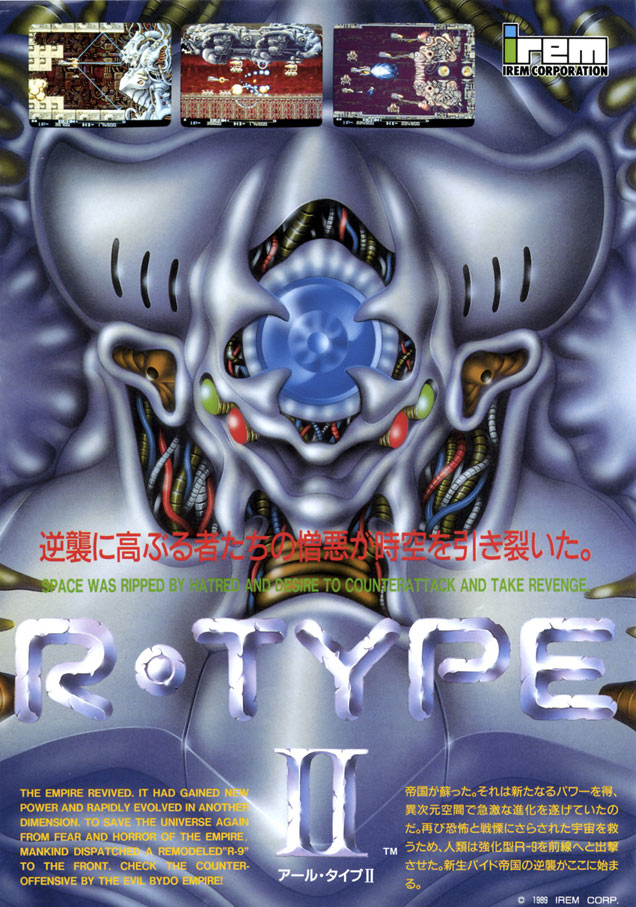
R-Type II
The game is the sequel to R-Type, which was first released as an arcade game in 1987 and profoundly influenced later shooting games with its charge shots, unique weaponry, and grotesque enemies. Hudson Soft ported the later 4 levels of the original R-Type to the PC Engine with the title R-Type II, but the Hudson release is unrelated to the game described in this article. The player controls a ship called the R-9C (or R-9 Custom), which is an improved version of its predecessor game's ship; the R-9. The ship's design was changed slightly, and the wave cannon was given homing capabilities. Two new types of weapons (the Search Laser and Shotgun Laser) were added, bringing the total number of weapon types up to five. A new anti-ground unit bomb was also added to the missile inventory. Though the number of levels was decreased from the prequel, the number of enemies, their durability, and the number of bullets they shoot were greatly increased. Enemy movements and terrain were also made trickier, bringing the game's difficulty up considerably. The same revival system is used as in the prequel, where the player is brought back to a checkpoint whenever their ship is destroyed. The controls are mostly unchanged from R-Type, where the 8-way joystick controls the ship's movement, and the shot button fires the ship's main beam. The other button is used to equip or unequip Force; the series' most unusual innovation. Pressing down the shot button causes the blue beam gauge to fill up, and releasing the button causes a wave beam to travel a certain distance depending on the length of time the button was pressed down. If the button is pressed down until the blue gauge is fully charged, a red gauge appears and fills up quickly. Filling up the red gauge causes it to flash blue and red, releasing the shot button at this point shoots an even more powerful beam. Unlike the normal beam that only travels in a straight line, the newly added Shotgun Laser beam explodes in multiple directions after traveling a short distance. This shot causes heavy damage if the player can target a single enemy with it. However, holding the button down after the gauge is flashing causes the beam to return to the normal transverse beam (the gauge alternates between flashing and returning to the normal state while the button is held down), so the player must release the button at the right timing in order to successfully target enemies. The other newly added beam, the Search Laser, is semi-homing, and can bend at angles up to 45°.
SCREENSHOTS
PHYSICAL
HISTORY
R-Type II is a horizontal scrolling shoot em up developed by Irem in the year 1989. It is the first sequel to the original R-Type and the second game in the series. Just like its predecessor, R-Type II has had several ports, more often than not downscaled in some way to make up for the different hardware (most notable one is Super R-Type for the Super Nintendo). The Arcade version has been ported to PlayStation as part of the R-Types compilation and R-Type Dimensions release.
Gameplay Overview
There are 6 stages with a second loop in R-Type II. Extends are granted at 200k, 350k, 500k and 700k points respectively.
Controls
A button (Press): Fires the player's weapons.
A button (Hold): Charges the Wave Cannon.
B button (Press): Controls the Force Pod.
Weapons
Wave Cannon
This is always available without the need of any power-ups. By holding the A button, the player can fire larger single shots, represented by the bar at the bottom of the screen. About a second after fully charged, the bar will go from light blue to gold, allowing the usage of several overlapping shots. There is a small window to use this, afterwards it will keep looping from blue to gold.
Force Pod
The Force Pod is obtained by collecting any laser items. It can block projectiles and deal contact damage. The pod works differently when it's attached or detached. While attached, it fires the respective laser weapon the player has in the direction it's currently facing. Pressing the B button will release the pod, making it fire bullets forward. This can be upgraded to a < shaped arc of bullets and it can additionally fire up and down when maxed.
The Force can be reattached by pressing the B button or simply flying close to it.
Laser
They are the upgrade to the main shot. Initially, picking up a laser item just makes the Force pod appear, level 2 makes the player fire the respective laser that was picked up and the third upgrade grants the strongest version of it.
Missile
Used alongisde the player's main shot. Unlike other weapons, they don't have any subsequent upgrades after the initial pick up. There are 2 different types of missiles available.
Bits
The bits are option items that follow the player. The first one is attached to the top of the player's ship and the second underneath. They can deal contact damage and fire while using the red laser.
Items
Loops
At the start of the second loop the player retains their missile and current movement speed, other upgrades are removed. Due to the higher difficulty bullets move faster, enemies fire more and most of them have higher HP.
Scoring
Stage 2
Near the halfway point of stage 2, several egg-like enemies will appear and drift upwards. Destroying them grants 200 points, but when they collide with the ceiling or other part of the stage's scenery they will spread into 3 smaller versions that slowly chase the player, each worth 100 points. For scoring purposes it's more benefitial to avoid defeating these until after they have spread.
Checkpoint Milking
Since there aren't endgame bonuses after clearing it's common for very high scoring runs to sacrifice lives during the run for more points. This is done on the second checkpoint of 2-6.
Version Differences
World Version
This is the international release of the Arcade version. It is considered easier than its Japanese counterpart.
Stage Differences
Stage 1:
A red enemy at the start has removed.
Many of the yellow enemies that rise from the water have been removed, including one that shoots from behind.
When the second snake appears, the hatch that is facing right releases enemies slightly later.
No walkers coming from behind after the large enemy with the laser appears.
Stage 2:
The third wave of kamikaze enemies that appears from behind is removed.
Right as the first bit drop appears, one enemy coming from behind has been removed.
Kamikaze enemies coming from behind near the end have been removed.
Stage 3:
After the Shotgun Laser drop, the missile item from one of the POW Armors has been changed from Homing Missile to Scatter Bomb.
Stage 4:
The second wave of wheel enemies that comes from behind now appears from the right side of the screen.
Right before the first section with the flying tanks, the laser item dropped from the POW Armor has been changed from Search Laser to Rebound Laser.
During the same section, a set of wheel enemies coming from behind has been removed alongside walker enemies appearing from both sides of the screen.
Wheel enemies appearing from both sides of the screen during the second wave of flying tanks have been removed.
The item from the last POW Armor has been changed from a Speed-up to a Counter-Air Laser drop.
Stage 5:
One of the last laser items in the stage has been changed from a Shotgun Laser to a Counter-Air Laser drop.
Stage 6:
After the large worm enemy that appears from behind, there is an additional POW Armor that drops a Scatter Bomb item.
R-Types
This was a compilation including both R-Type and R-Type II released for the PlayStation. Both games run at 60Hz instead of 55.
R-Type Dimensions
Based on the World release.
The game can be played with its original look or 3D graphics. The 3D mode supports simultaneous co-op play, player 2 controls a black colored R9C with a green windshield and Force Pod.
References
↑ Masahiko Ishida – 2014 Composer Interview
↑ “I made that!” – 1991 Developer Interviews
↑ Domestic and Overseas Arcade Game List 1971-2005
↑ Domestic and Overseas Arcade Game List 1971-2005
1CC RUNS
One-credit clears we point to as the benchmark for this game.
GAMEPLAY VIDEO
SCORES
RELEASES 7 systems
PHYSICAL RELEASES 1 box