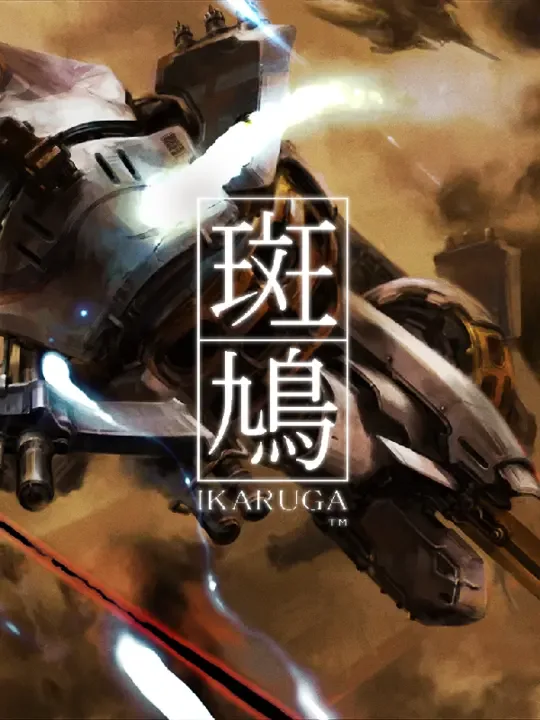
Ikaruga
In this vertical scrolling spaceship shooter, you control a ship that can change its polarity at will. As blue/white, the ship can easily destroy red/black enemies, and vice versa. Bullets of your polarity can be collected to fuel your energy gauge, but those opposite will kill you. Destroying an enemy ship causes them to fire revenge bullets which can be absorbed and fired back by the player. Different difficulties exist to change exactly how you interact with polarized points, or how they appear. It is the spiritual successor to Radiant Silvergun, featuring similar level and boss design, as well as it's buddhism inspired themes and aesthetics. Both are directed by Hiroshi Iuchi, who also composed Ikaruga's soundtrack.
SCREENSHOTS
PHYSICAL
HISTORY
Ikaruga (Japanese: 斑鳩; lit. 'Japanese grosbeak') is a bullet hell game developed by Treasure. It is the spiritual sequel to Radiant Silvergun (1998) and was originally released in Japanese arcades in December 2001. The story follows a rebel pilot named Shinra as he battles an enemy nation using a specially designed fighter called the Ikaruga which can flip between two polarities, black and white. This polarity mechanism is the game's key feature and the foundation for its stage and enemy design. All enemies and bullets in the game are either black or white. Bullets which are the same color as the player are absorbed while the others will kill the player. The game features both single-player and cooperative modes.
Development on Ikaruga began during director Hiroshi Iuchi's off-hours while Treasure was busy developing Sin and Punishment (2000). Titled "Project RS2", the game began as a sequel to Radiant Silvergun, and borrows many elements from it as well as the polarity mechanism from Treasure's Silhouette Mirage (1997). During the game's prototype stages, the player's ammo was limited. The bullet absorption mechanism was used as a means to refill ammo. However, this was found to be weak as it created too many breaks in the action so it was later added as an additional mode in home ports. In tradition with Treasure's game design philosophy, Ikaruga was intentionally crafted to challenge the conventions of standard game design and develop a new type of shooting game. All together, five Treasure staff worked on Ikaruga, as well as three support staff from G.rev.
Upon its initial release in Japanese arcades, reception was mixed. Treasure staff explained this was due to players expecting a more standard shooter offering but instead being greeted with a different game system that featured more puzzle-like elements rather than the twitch gameplay of bullet-dodging. In 2002, Ikaruga was ported to the Dreamcast in Japan and began to grow a cult following from import gamers worldwide. It was later released in the West in 2003 on the GameCube, receiving positive reviews. Critics praised the graphics as well as the art and sound design. Some criticism was directed towards its difficulty. Most critics felt the unique game design choices were innovative, while some believed they stifled many of the classic shooter elements. Ikaruga was later ported to the Xbox 360, Windows, Nintendo Switch, and PlayStation 4. In retrospect, Ikaruga is regarded by critics as one of the best games ever made, especially in the shoot 'em up genre, and one of Treasure's greatest works.
Gameplay
Ikaruga is a vertically scrolling shoot 'em up. The game features five stages, three levels of difficulty, and supports single-player or two-player cooperative modes. The player pilots the Ikaruga fighter, moving to avoid obstacles and other danger. A key gameplay feature to Ikaruga is its polarity system. The player can press a button at any time to switch the polarity of their ship between black and white. When white, the ship will absorb white bullets fired by enemies and store their power until released with a special attack. However, if the ship is white and hit by black bullets, it will be destroyed. The opposite is true when the ship is black. Enemy fighters also have black and white polarities. If the player ship is white and the enemy is black, the player's bullets will do twice the damage than if their ship was black. If an enemy is destroyed with the same polarity as the player, the ship will expel energy which can be absorbed or, if the player changes polarities too quickly, present a fatal danger.
Ikaruga does not feature any pick-ups or power-ups, instead, the player can only rely on their standard firing weapon and a homing laser. Absorbed bullets contribute to building the player's homing laser attack. The power of the attack increases one level for every 10 enemy bullets absorbed. Each level is equal to one laser, with a maximum of 12 which can be stored. A homing laser is 10 times more powerful than a standard shot. The game's scoring system is based upon chaining attacks to earn bonuses. Destroying three enemy fighters of the same color in a row will earn the player a chain bonus. The player will earn 100 points for their first chain bonus, and double the amount for each bonus thereafter. These bonuses can be multiplied up to a maximum of 25,600, but if interrupted by destroying an enemy out of order, the bonus will be reset.
Home console ports of Ikaruga feature additional gameplay modes apart from the standard arcade mode. Modes are available that allow players to practice single stages they have unlocked at normal or slow speeds. A challenge mode is available which logs players' scores and compares them to others worldwide. If certain conditions are met, a prototype mode is unlocked which limits the number of bullets the player has. Bullets must be absorbed to keep ammo in stock. In an alternative way to play the standard game called "Bullet Eater", the player does not fire any shots and instead navigates through all the stages by absorbing bullets.
Synopsis
Many years ago on the island nation of Horai, leader of the nation, Tenro Horai, discovered the Ubusunagami Okinokai (lit. The Power of the Gods). This energy emanated from an object she dug up from deep underground, which granted her unimaginable powers. Soon after, Tenro and her followers, who call themselves "The Divine Ones", began conquering nations one after another. "The Divine Ones" carried out these conquests in "The name of peace".
A freedom federation known as The Tenkaku emerged to challenge Horai. Using fighter planes called Hitekkai, they fought with the hope of freeing the world from the Horai's grips, but their efforts were in vain, as they were no match for The Horai and were almost completely wiped out. Miraculously, however, one young man called Shinra (森羅) survived the battle.
Shot down near a remote village, inhabited by elderly people who were exiled by the Horai's conquests, Shinra was rescued from the wreckage and was nursed back to health. Shinra pledged to defeat the Horai, and the villagers entrusted him with a fighter plane designed by former engineering genius Amanai with the help of the village leader Kazamori, called The Ikaruga. Hidden in a secret underground bunker and launched via the transportation device called "The Sword of Acala", Ikaruga is the first fighter to be built with both energy polarities, and is capable of successfully switching between the two.
Shinra battles against the Horai across the game's five stages, and ultimately faces Tenro Horai herself. He destroys her ship, killing her and releasing the octahedron-shaped object stored inside, which appears to be the source of the Power of the Gods and partly resembles the Stone-Like object featured in Treasure's previous game Radiant Silvergun. Shinra releases the Ikaruga's restraint device and unleashes a massive attack to destroy the object for good, sacrificing himself in the process as the ship overheats and explodes.
In the two-player game, Shinra is accompanied by Kagari (篝), a mercenary of the Horai defeated by Shinra. After Shinra spared her life, she decided to fight against Horai alongside the resistance. Her ship, The Ginkei, was modified by the people of Ikaruga village to give it the ability to switch between the two polarities, like the Ikaruga. Kagari's fate at the end of the game is the same as Shinra's, dying as her ship is destroyed in the final attack against the object.…
1CC RUNS
One-credit clears we point to as the benchmark for this game.
Show all 172 runs
GAMEPLAY VIDEO
STORES
Prices are cached from each storefront and may be out of date. Last checked 24 Sept 2026.
PRICE HISTORY
Every price change we know of, per shop. Flat means the price held; PC shops reach back through IsThereAnyDeal's archive, console shops start when this site started watching.
Epic Games Store low: $7.49 (21 Nov 2022) , Steam low: $4.99 (25 Jun 2026) , Xbox low: $3.29 (28 Aug 2026)
REVIEWS
Published elsewhere, collected here. Every score is the outlet's own, on the outlet's own scale. Follow the link for the full review.
“In the end, if you've played Ikaruga on any other previous platform, then you've played what is available on the Switch. However, that's also the beauty of it all. Ikaruga is a timeless classic and a game that is worth picking up again and again. The main question is should you pick it up. With the obvious answer being, HELL YES. Casual gamers will welcome the challenge, while SHMUP masters will feel right at home. And now you can take it on the go!”
“Ikaruga is an outstanding classic, which I find myself mentioning to anyone who will listen. It is a defining game in the shooting genre that all gamers should experience. The Switch version is true to the arcade, but goes above and beyond with the portable vertical play and global leaderboards. Don’t miss out!”
“Ikaruga is one of those games I'll happily rebuy and replay every time there's a new port, but with this Switch version, I should be set. Being able to easily bust out the Joy-Con controllers for co-op and flip the system on its side for a vertical screen orientation is the real deal. Ikaruga is a timeless classic, and for those of us without a swiveling monitor, the Switch is just about the ideal way to experience it.”
“Ikaruga on Switch instantly becomes the definitive version of Treasure masterpiece, without any misstep in a truly excellent package.”
“Ikaruga has gone down in history as one of the most difficult games ever, but in recent years, between one Dark Souls and another, the perception of difficulty has changed. This edition for Switch is the perfect opportunity to (re)discover one of the most beautiful shoot'em ups ever, a title that had made the "severe but fair" its flag before the much-talked-about masterpiece by From Software.”
“While the latest package of Ikaruga isn't quite the grand celebration it should be for a classic title, Treasure's shooter has aged fantastically well. The puzzle-like shooting is just as thrilling and demanding as it was back in 2002, and it's sure to challenge any fan of shooters. Ikaruga's themes of polarity help it stand out from the bullet hell crowd, and make it one of the finest shoot 'em ups that can be purchased on Switch.”
“The physical Gamecube release can be a bit pricey these days, so the $14.99 Switch price tag is not much in comparison. If you can get over the initial learning curve, Ikaruga is a game that will truly challenge your reflexes and abilities to think on the spot. The game may only be about 40-minutes long, but you will more than likely be coming back for more to see how you stack up against the world in the online leaderboards. One of the biggest problems Ikaruga had was that it was not the most accessible game as physical copies of the Gamecube version are a bit uncommon today and the Japanese ”
“Small performance hiccups on boss explosions aside, which were already present in an even worse state back on the GameCube, this is the new definitive edition of the great classic on Nintendo Switch. Not only is it enjoyable and fully featured both at 1080p60 in docked mode and 720p60 in handheld mode, but it is obviously way more enjoyable on the go than the version available for smart devices due to real built-in controls but also, for the first time, portable two-player mode on the same device with split Joy-Con, which happens to work really well. It is still as challenging a romp as it eve”
“This is the best version of the best (or one of the top three, in any case) shoot'em up ever, with a glorious TATE mode and a 2-player coop that will both blast you. Do we need to say more?”
“Treasure's cult 2D shooter remains as uniquely entertaining as always and works extremely well on the Nintendo Switch.”
“If you've ever been a fan of Ikaruga and own a Switch, this port is absolutely essential.”
“As it always has been, Ikaruga is a must-play for anyone even remotely interested in shoot 'em ups.”
“After so many subsequent ports and re-releases, little love is lost in a game whose age only elevates its timelessness and whose gracious-but-clever philosophy on enemy engagement makes it a thoroughly unique affair in general.”
“It's long been known that Ikaruga is one of the true classics of the top-down shooter world, but going back to the game again on the Nintendo Switch really cements that legacy. This is a brutal but beautiful, relentless yet rewarding, and frantic yet fun bullet hell challenge that feels as fresh now as it did 17 years ago in its original arcade release.”
“Overall, Ikaruga remains a treasure in the shoot 'em up genre due to its tight gameplay, challenge, and overall design.”
“Ikaruga is a classic shoot 'em up in every sense of the word and I'm happy to say that it holds up beautifully after over 15 years.”
“Overall, Ikaruga is a great shooter but not quite what I was expecting. The length of the game combined with the difficulty may deter most people but the game is customizable enough to be fun for anyone. The game even features a couple 2-player options so you can invite a friend along for the ride. If you're a fan of shooter games, Ikaruga is definitely worth checking out. From the combo system, to the light/dark switching, it offers some unique gameplay elements even for genre veterans. Just be ready for a healthy challenge!”
“There's almost as high a degree of memorization to Ikaruga as skill as you can only improvise your way through challenges like this so much. True success will only come from having familiarity with where to go, what to do, and then almost a degree of muscle memory to help you perform ballet between bullets flying everywhere. If you've been looking for a game that's somewhat light on total content but that compensates with a demand for approaching perfection Ikaruga is as tough as they come. But, if you were hoping for something a bit more light and fun you can absolutely pass, this is a game t”
“Ikaruga is a classic, but it’s not a game for everyone. It confidently dwells in its genre and is designed to cater to a specific audience. It won’t alter the perception of those who aren’t thrilled about shoot-em-ups, and neither is it meant to.”
“Ikaruga has a reputation that is known well enough in the shoot'em up genre: its gameplay mechanic and difficulty level helped it build its name and now, Nintendo Switch players have the chance to enjoy this classic. While it does not add anything new to the original, Ikaruga on the Nintendo Switch expands the game's audience further and allows players on the new Nintendo console to get their hands on this merciless work, which might prove too frustrating for those not used to this level of challenge.”
Reviews are the work of the outlets named. Titles, scores and quoted excerpts are reproduced for identification and criticism; each links to the original.
SCORES
ACHIEVEMENTS 1 set
Tracked by RetroAchievements and earned in an emulator that reports to it. A game tracked on more than one machine gets a set for each, because they are different lists earned on different hardware.