Espgaluda
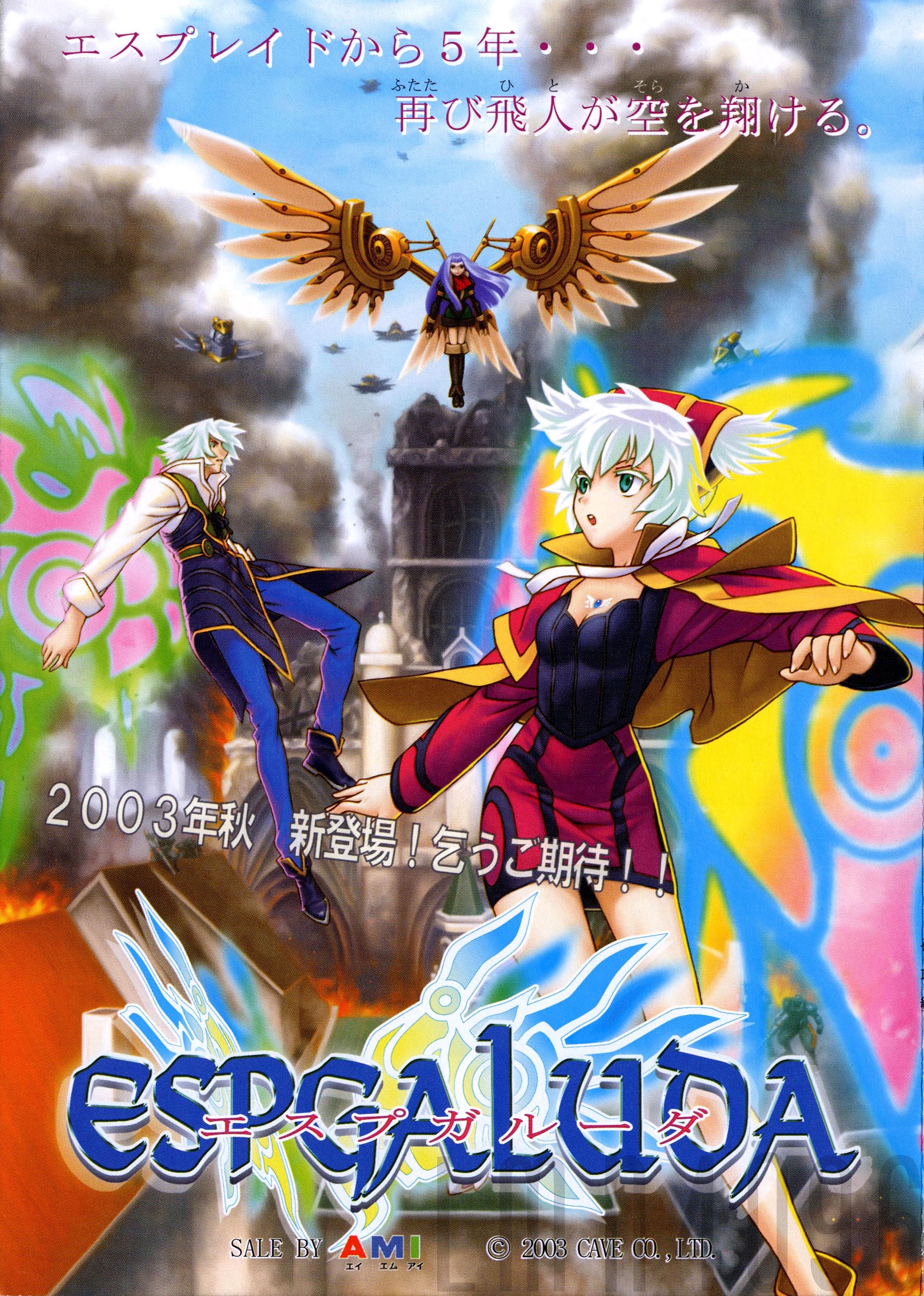
A great vertically scrolling manic shooter. In an otherwise peaceful world, the Shinra Empire began conquering nearby nations one by one to expand their territory gradually. Meanwhile, in the Shinra weapons lab, the Espgaluda project produced two successful prototypes: Agaha and Tateha. Fearing for their future, the project's head scientist, Hiodoshi, escaped with the two prototypes to a nearby kingdom, but time after were found by Shinra's troops and Hiodoshi was killed by the attack of the imperial army, the power of the galuda has awaken. You have the option of controlling one of two siblings each with different skills, Ageha faster but with narrower shooting capabilities or Tateha slower but with a wider attack. As you fly through the various stages various mechanical enemies attack with a high number of bullets, often nearly filling the screen. Aside from the regular shots, Ageha and Tateha also have additional abilities which help the player navigate through the numerous bullets. The first is a guard barrier; when activated the player is immune to collisions and as a bonus when the barrier button is released a more powerful laser shot is fired. A meter at the bottom of the screen indicates how much power is left in the barrier. The second ability is called the Kakusei mode; when this mode is activated your character gender is altered and is able to fire a more powerful shot. More importantly, when this mode is activated all of the enemies and their bullets slow down considerably while the players speed remains the same making it easier to navigate through a tricky pattern of bullets. Activating Kakusei mode will rapidly deplete the players supply of green gems; since the number of gems isn't limitless the player may not be able to remain in Kakusei mode for long. When not in Kakusei mode additional gems can be collected by destroying the various enemies. If the player completely runs out of gems, enemy bullets begin travelling faster than usual. Another bonus in the game is gold inguts which greatly increase the players score. These are found when in Kakusei mode; when an enemy is destroyed, all of its bullets will turn into ingots which can be collected by the player.
SCREENSHOTS
PHYSICAL
HISTORY
Espgaluda is a 2003 manic shooter by Cave and published by AMI. It is the spiritual successor to ESP Ra.De. and is followed by Espgaluda II.
Gameplay
Espgaluda is an arcade game which involves firing bullets and lasers at enemies, with the ultimate goal being to gain points and make it through all of the game's levels. The player character has an energy gauge that can be depleted either by using a shield attack or being hit by a bullet, which activates an automatic guard barrier. When this barrier is activated, the player fires a laser and is momentarily invincible. If the gauge is depleted when the player character is hit by the bullet, the player loses a life. The player collects gems and, when they enter Kakusei mode, the gem counter drains. While draining, the enemies turn purple, and the bullets and enemies begin to move more slowly. When enemies are defeated, their bullets turn gold, which adds to the score multiplier. When it ends, the player goes into Kakusei Over mode, where bullets turn red and travel faster than normal.
Development
Espgaluda was produced by Kenichi Takano and directed by Tsuneki Ikeda, co-founders of Cave whose previous works include the DonPachi series. Ikeda also served as co-programmer alongside Takashi Ichimura. Akira Wakabayashi, Hideki Nomura, Hiroyuki Tanaka and Kengo Arai also acted as co-designers. Artist Tsukasa Kado was responsible for both world building and character designs. The soundtrack was composed by "SOU1" under supervision of Toshiaki Tomizawa, another co-founder of Cave. The team recounted its creation process and history through various publications.
Release
Espgaluda was first released in arcades by AMI in November 2003. A soundtrack album containing music from the game was published in Japan by Cave in March 2004. The same year in June, a conversion for the PlayStation 2 was developed and published by Arika in Japan. This version included different modes such as arcade, simulation, arrange, and a walkthrough DVD video featuring high-level replays. In arcade mode, players can configure screen orientation and other settings. Simulation mode simulates an arcade mode stage where players can practice of sections under pre-defined conditions. Arrange mode is a PlayStation 2-exclusive feature and introduces more aggressive enemy patterns, new playable characters, an arranged soundtrack, among other additions and gameplay changes.
In 2005, Espgaluda was split into two separate parts and distributed by Cave through the Gaesen Yokocho service for EZweb, i-mode and Yahoo Mobile phones. Both parts were later merged into a single release titled Espgaluda DX, featuring enhanced graphics and a special mode.
Reception
Espgaluda garnered positive reception from critics who reviewed it as an import title, with the PlayStation 2 conversion being regarded by outlets like Kotaku Australia and TheGamer as one of the best shoot 'em ups on the console. According to Famitsu, the PlayStation 2 version sold over 10,125 copies in its first week on the market and approximately 17,755 copies were sold during its lifetime in Japan.
Famitsu's four reviewers gave the PlayStation 2 conversion a positive outlook. Game Watch's Toyotomi Kazutaka praised the extra additions of the PlayStation 2 port such as arrange mode, as well as its "Kakusei" and guard barrier mechanics. Edge commended the PlayStation 2 release for its accessibility, "Kakusei" and guard barrier mechanics, scoring system and extra modes but criticized the loss of visual fidelity due to screen resolution differences. Consoles +'s Kael also gave positive remarks to the PlayStation 2 version for its gameplay and music but criticized the short length. Hardcore Gaming 101's Craig Gabrielson noted its scoring system and accessibility in a positive light but criticized the visual variety in terms of stages and soundtrack.
1CC RUNS
One-credit clears we point to as the benchmark for this game.
Show all 83 runs
ACHIEVEMENTS 1 set
Tracked by RetroAchievements and earned in an emulator that reports to it. A game tracked on more than one machine gets a set for each, because they are different lists earned on different hardware.
RELEASES 2 systems
PHYSICAL RELEASES 1 box