Darius Gaiden
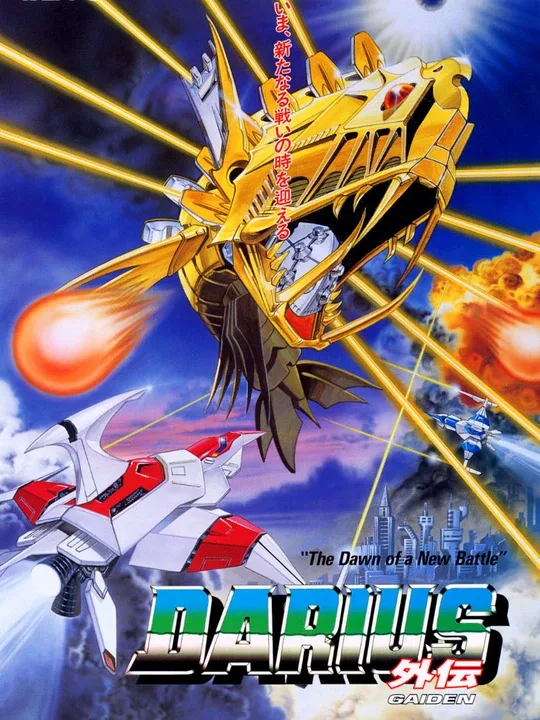
Darius Gaiden is a two-dimensional shoot'em up. The player controls a space ship named the Silver Hawk and must guide it through scrolling stages, destroying enemies and avoiding obstacles along the way. The ship is armed with forward-firing missiles, aerial bombs and a protective force-field, all of which can be upgraded by various power-ups that are dropped by specially-colored enemies when they are destroyed by the player. New to the Silver Hawk's arsenal in Darius Gaiden is the 'black hole bomb.' When fired, the black hole bomb will create a large vortex in the center of the screen, which sucks in enemies and projectiles on the screen for a short moment, until it explodes into a powerful ball of lightning that inflicts massive damage onto every enemy on the screen. Another feature introduced Darius Gaiden is the ability to capture minibosses, who appear in every stage. Each miniboss has a small, circular ball placed on them that, after receiving enough damage, will detach and float away, causing the miniboss to turn idle. If the player collects the ball, the miniboss will follow and aid the player. After a brief period of time, or the player loses a life, the miniboss will explode. A few months following release, update to the arcade version was later released entitled "Darius Gaiden Extra Edition". This version of arcade game contains rearranged levels, as well as automatically-enabled auto fire, two extra weapon power levels (bigger wave shot and a bigger red wave shot as well) and an all-stage mode which can be accessed by starting the game in 2P side.
SCREENSHOTS
PHYSICAL
HISTORY
Darius Gaiden is a 1994 horizontal-scrolling shooter arcade game developed and published by Taito. The fifth entry in its Darius series, players control a starship named the Silver Hawk in its mission to destroy the Belsar empire before it wipes out the population of planet Darius. Gaiden adds several new features to the core concepts of its predecessors, including screen-clearing black hole bombs and the ability to capture mid-level bosses. The game has been ported to several consoles, including the Sega Saturn and PlayStation.
Created by producer Hidehiro Fujiwara, Darius Gaiden was designed to show off the technological capabilities of Taito's then-new F3 System, an arcade board that utilized interchangeable cartridges. Though he had little exposure to the series, Fujiwara wanted to design a new Darius game that improved on its established concepts. The development team worked to retain many of the franchise's core elements while also focusing on creating a new and engaging experience. Originally titled Darius III, its name was changed to Darius Gaiden as its plot took place between the first two games; gaiden is the Japanese term for "side story".
Darius Gaiden was critically acclaimed in arcades, and received several awards. The home console conversions were also well received, with critics applauding its gameplay, attractive visuals, and responsive controls. Some felt its music was bizarre and unfitting, while some enjoyed its outlandish nature. Retrospectively, it has been ranked among the greatest side-scrolling shooters of all time. It was followed by G-Darius in 1997.
Gameplay
Darius Gaiden is a horizontal-scrolling shooter video game. The player controls a starship named the Silver Hawk in its mission to obliterate the Belsar empire, which is plotting to destroy what is left of the human race and their new home of planet Darius. A second player can join in at any time. The game uses a non-linear level progression system where players can select whichever level they choose after completing the previous one. There are twenty-seven stages total, with the player only being able to play seven of them at a time. In these levels, the Silver Hawk must destroy constantly moving formations of enemies while avoiding their projectiles, as well as dodging obstacles. Enemies are made to resemble fish, crabs, seahorses, and other aquatic creatures. Levels conclude with a boss that must be defeated by destroying its weak spot, such as its head or mouth.
The Silver Hawk begins the game with a forward-moving shot. Collecting colored emblems dropped by correspondingly colored enemies allows the player to power-up the Silver Hawk's abilities. Green emblems grant the player missiles, red emblems increase the length and power of shots, and blue emblems give the player a protective shield. Collecting additional emblems upgrades the player's weapons, such as a stronger shield or missiles that move forwards and backwards. The Silver Hawk also begins the game with three black hole bombs. Firing them creates a large swirling vortex that sucks in all enemies and projectiles, followed by lightning strikes that inflict massive damage on enemies. The Silver Hawk also has the ability to capture minibosses, which appear in the middle of most levels. This is accomplished by destroying the energy orb on its head and collecting it when it flies off. Captured minibosses ally with the player and fire their own weapons at enemies for a brief period of time, before they self-destruct.
Development
Darius Gaiden was published by Taito as the third arcade installment in its Darius series, and the fifth entry overall. Its development was headed by producer Hidehiro Fujiwara, who was alongside designer and artist Hirokazu Kato, and programmer Akira Kurabayashi. Fujiwara had little exposure to the series aside from assisting in production of the original Darius. Nonetheless, he was a fan of the first game, and was ready to work on a sequel that could improve on concepts established by its predecessors. When Fujiawara was conceiving the idea for Gaiden, Taito released its F3 System, an arcade system board that allowed arcade operators to swap out games through interchangeable ROM cartridges, similar to the Neo Geo. Taito wanted big-name franchises to appear on its new board to increase awareness and attract attention, so Fujiwara proposed the idea of a Darius game as the series was well known in Japan. Taito approved the request and allowed development of Darius Gaiden to begin.
The original Darius and its sequel Darius II both used three individual monitors made to appear seamless via mirror effects. Kato insisted that Gaiden scrap this concept and use a single-screen display, as he felt the concept had grown old by that point. During production, the development team focused on making the game fun to play and unlike any other shooter before it to make it stand out. Fujiwara and the others also wanted the game to show off the technical capabilities of the F3 System, such as its sprite rotation and 3D effects. The game was originally titled Darius III, which was used in overseas marketing material. Due to the story taking place between Darius II and the first Darius, Kato decided to name the game Darius Gaiden, with "gaiden" being a Japanese term for "side story".
Though the team worked to make Gaiden feel fresh and new, they also focused on implementing many of the franchise's core concepts to make it feel like a proper sequel. Returning ideas include a similar stage structure, formidable opponents such as King Fossil and Vermilion Coronatus, and a proper storyline. The game's presentation was also a focal point; the programmers worked to add a number of flashy effects that showed off the F3 System's technological capabilities, though this also complicated the process of making sprites. Some characters, including the first stage boss Golden Ogre, were 3D models pre-rendered as 2D sprites. The midboss capture mechanic, a concept borrowed from an older Taito game, was thought to have made the game more complicated or unbalanced and was almost excluded from the final version.
Music
The soundtrack for Darius Gaiden was composed by Zuntata, the house band of Taito. The band's leader, Hisayoshi Ogura, was the director of the music. Ogura based its music on Jungian archetypes, presenting them in an operatic fashion. He describes the music for the first level, "Visionnerz", as being "the collapse of the ego given musical form". It uses lyrics pulled from other sources, which are based on the idea of "truth isn't what lies in front of you". Ogura intended the music to represent the game's dream-like stages and atmosphere. In an interview, he said: "If you were looking at something and it changed in front of your eyes, and you suddenly realized that everything you thought was an indisputable truth a second ago wasn't true at all, that would be a considerable shock to you. People in such situations would be unable to maintain their composure. They'd start to break down mentally. That's the kind of concept I wanted to convey through "Visionnerz" and the music of Darius Gaiden". The band's sound engineer, Katsuhisa Ishikawa, designed the game's sound effects.
The entire soundtrack was completed in order, with "Visionnerz" being the source of inspiration for most of the music. Unlike Taito's other game soundtracks, the one for Gaiden is synchronized to the gameplay and sound effects, which was possible through constant communication between programmers and sound designers. For the final stages, the music was made to change in tone when the boss shows up, creating an intense and ominous atmosphere. Ogura has claimed that Darius Gaiden is his favorite soundtrack in terms of direction.…
STORY
Shortly after the events of the first Darius, protagonists Proco and Tiat help refugees from the planet Darius flee from the destruction caused by the Belser Army. They eventually find and set up a temporary colony on a planet named Vadis. Suddenly, Belser rises again and launches a surprise attack on a spaceport on Darius, which was being used to help ferry the remaining Darians to Vadis. The remaining refugees are killed, and Belser sets course for Vadis. A fleet of Silver Hawks are sent to fend off Belser, but are easily annihilated. Once again, Proco and Tiat are given no choice but to fight off Belser once more.
1CC RUNS
One-credit clears we point to as the benchmark for this game.