Carrier Air Wing
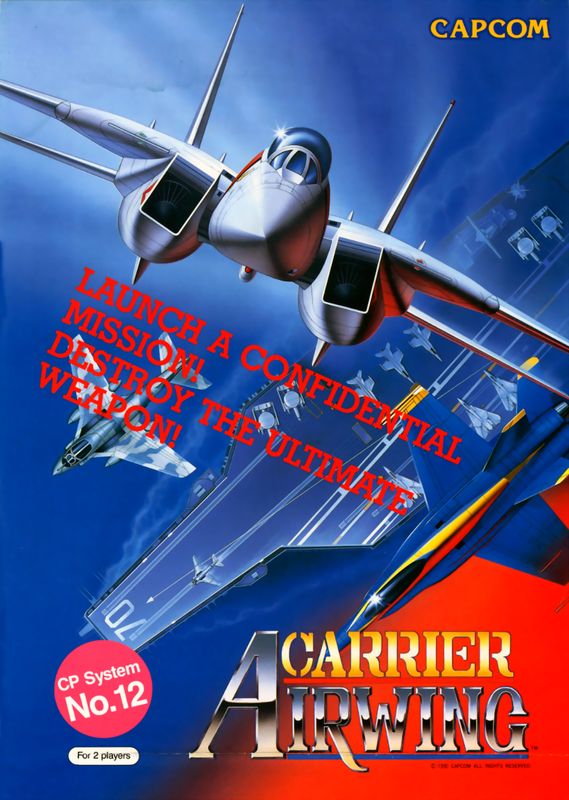
The 1990s was a decade of great change marked by growing friendships between old enemies and never before seen levels of co-operation between powerful nations of the world. However, in 1997, using new weapons designed in secrecy, the Middle Eastern country of Rabu threatened to destroy this fragile peace. Rabu's proported goal is to purge the world of sin and force a new morality, with her allies. Rabu quickly claimed the Middle East, then spread into both southern Asia and parts of Europe. Their weaponery is terrifyingly eeficient at manufacturing death. They seemed unstoppable. When they gassed Tokyo in 1999, U.S. intervention became unavoidable. If Rabu is allowed to use Japan's manufacturing facilities, there will be no end to the nightmare. Hoping to protect world peace, the USS Carl Vinson (CVN-70) heads out to the sea.
SCREENSHOTS
HISTORY
Carrier Air Wing, released in Japan as U.S. Navy, is a 1990 side-scrolling shooter video game developed and published by Capcom for arcades. It is the spiritual successor to U.N. Squadron, which was released in the previous year. A version for the Capcom Power System Changer was planned and previewed but never released. It was later re-released on Capcom Arcade Stadium.
Gameplay
As with the original, players chose any one of three different jet fighters and battle their way through ten enemy-packed stages. Other ideas carried over from U.N. Squadron include the shop, which allows players to buy weapon and shield upgrades for their jet fighter between stages, and the energy bar, which is replaced by a "fuel bar" which starts full at the start of each stage and decreases as time passes with some fuel lost each time the plane is damaged. The game has two different endings, depending on whether the game is finished with only one coin or not.
Reception
In Japan, Game Machine listed Carrier Air Wing on their December 1, 1990 issue as being the most-successful table arcade unit of the month, outperforming titles such as Raiden and Columns II. In the January 1991 issue of Japanese publication Micom BASIC Magazine, the game was ranked on the number eight spot in popularity. In May 1991, UK magazine Zero ranked it on their number three spot in popularity. Martin Gaksch of German magazine Power Play gave the game a mixed outlook.
1CC RUNS
One-credit clears we point to as the benchmark for this game.