
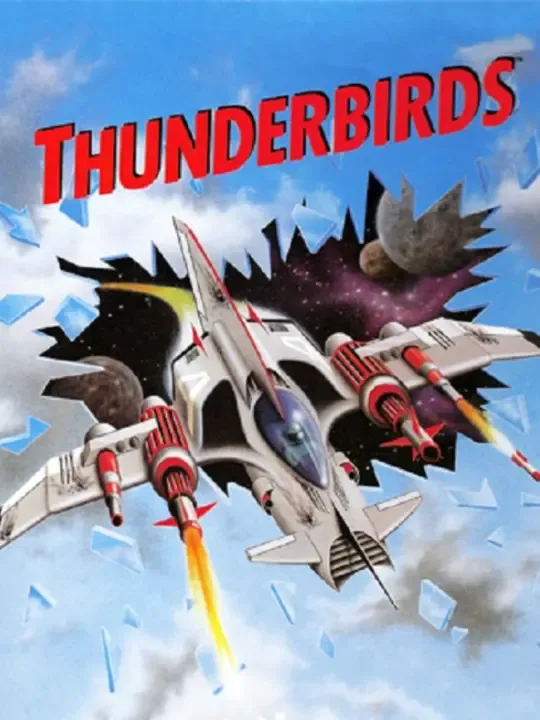
Thunderbirds
A NES version of "Thunderbirds" was released by Activision in 1990.
SCREENSHOTS
PHYSICAL
HISTORY
Thunderbirds is a British science fiction television series created by Gerry and Sylvia Anderson, filmed by their production company AP Films (APF) and distributed by ITC Entertainment. It was filmed between 1964 and 1966 using a form of electronic marionette puppetry called "Supermarionation" combined with scale model special effects sequences. Two series, totalling 32 fifty-minute episodes, were made; production ended with the sixth episode of the second series after Lew Grade, APF's financial backer, failed in his efforts to sell the programme to US network television.
Set in the 2060s, Thunderbirds was a follow-up to the earlier Supermarionation productions Four Feather Falls, Supercar, Fireball XL5 and Stingray. It concerns the exploits of International Rescue,
a life-saving organisation with a secret base on an island in the Pacific Ocean. International Rescue operates a fleet of technologically advanced rescue vehicles, headed by five craft called the Thunderbird machines. The main characters are the leader of International Rescue, ex-astronaut Jeff Tracy, and his five adult sons, who pilot the Thunderbirds.
Thunderbirds premiered in September 1965 on the ITV network and has since aired in at least 66 countries. Besides tie-in merchandise, it was followed by two feature films: Thunderbirds Are Go and Thunderbird 6. Periodically repeated, it was adapted for radio in the 1990s and has influenced many TV programmes and other media. Its other adaptations include an anime reimagining (Thunderbirds 2086), a live-action film (Thunderbirds) and a part-CGI, part-live-action remake (Thunderbirds Are Go). Three supplementary episodes, based on tie-in audio plays and made using the same puppet techniques as the original series, have also been produced.
Widely regarded as the Andersons' most popular and commercially successful series, Thunderbirds has been praised for its special effects, directed by Derek Meddings, and its musical score by Barry Gray. It is also remembered for its title sequence, which begins with an oft-quoted countdown by Jeff Tracy voice actor Peter Dyneley: "5, 4, 3, 2, 1 – Thunderbirds Are Go!" A real-life search and rescue service, the International Rescue Corps, was named after the organisation featured in the series.
Premise
Set between 2065 and 2067, Thunderbirds follows the exploits of the Tracy family, headed by American industrialist and ex-astronaut Jeff Tracy. Jeff is a widower with five adult sons: Scott, John, Virgil, Gordon and Alan. The Tracys make up International Rescue, a secret organisation founded to save human life. They are aided in this mission by technologically advanced land, sea, air and space vehicles that are called into service when conventional rescue methods prove ineffective. The most important of these vehicles are the five "Thunderbird machines", each assigned to one of the five Tracy brothers:
Thunderbird 1: a hypersonic rocket plane used for fast response and danger zone reconnaissance. Piloted by Scott, rescue co-ordinator.
Thunderbird 2: a supersonic carrier aircraft which ferries supporting vehicles and equipment in detachable capsules called "pods". Piloted by Virgil.
Thunderbird 3: a single-stage-to-orbit spacecraft. Piloted alternately by Alan and John, with Scott as co-pilot.
Thunderbird 4: a utility submersible. Piloted by Gordon and usually launched from Thunderbird 2.
Thunderbird 5: a space station in Earth orbit that relays distress calls from around the world. Manned alternately by "space monitors" John and Alan.
The family live on Tracy Island, International Rescue's secret base of operations in the South Pacific Ocean. They own a luxurious villa that they share with four other people: Grandma Tracy, Jeff's mother; scientist and engineer Brains, who designed the Thunderbird machines; Brains' assistant Tin-Tin, who is also Alan's girlfriend; and Tin-Tin's father Kyrano, the Tracys' retainer. In this remote location, International Rescue is safe from criminals and spies who envy its technology and attempt to acquire the secrets of the Thunderbird machines.
Some of International Rescue's operations are triggered not by innocent misadventure, but rather sabotage or criminal negligence. For missions involving undercover work, the organisation incorporates a network of field agents led by English aristocrat Lady Penelope Creighton-Ward and her butler Aloysius Parker. Based at Creighton-Ward Mansion in Kent, Penelope and Parker travel in FAB 1: a specially modified, pink Rolls-Royce. International Rescue members acknowledge orders with the expression "FAB" (a shortening of the 1960s buzzword "fabulous", spoken as an initialism: "F-A-B").
International Rescue's most persistent opponent is a master criminal known as The Hood. Based in a temple in Malaysia, and possessing powers of hypnosis and dark magic, The Hood exerts telepathic control over Kyrano, his estranged half-brother, and manipulates the Tracys into rescues that unfold according to his own designs. This gives him opportunities to spy on the Thunderbird machines and, by selling their secrets, make himself rich.
Production
Development
Thunderbirds was the fifth series to be co-created by Gerry Anderson and filmed by his production company APF, whose studios were located on the Slough Trading Estate. Pitched in 1963, the series was commissioned by Lew Grade of ITC, APF's parent company, following the commercial success of Stingray.
The series' premise was inspired by the West German mining rescue known as the "Wunder von Lengede" (Miracle of Lengede). In October 1963, the collapse of a nearby dam flooded an iron mine in the municipality of Lengede, trapping 50 men underground. Efforts to save them were hampered by the length of time it took to bring rescue equipment to the site. Lacking the means to drill an escape shaft, the authorities were forced to requisition a heavy-duty bore from Bremen, more than 80 miles (130 km) away, and transport it to Lengede by train, in a journey that took eight hours. In the end, 21 miners were saved and the other 29 died. Seeing the advantages of faster emergency response, Anderson came up with the idea of an "international rescue" organisation that uses supersonic aircraft to transport equipment quickly over long distances.
Wanting to set this concept apart from APF's earlier productions, Anderson tried to pitch the stories at a level that would appeal to both adults and children. Whereas earlier series had aired in afternoon children's timeslots, Anderson wanted Thunderbirds to be shown during the evening to attract a wider family audience. Series co-creator Sylvia Anderson recalled that "our market had grown and a 'kidult' show [...] was the next step." The Andersons retired to their holiday villa in Portugal to expand the premise, script the pilot episode and compose a writers' guide. According to Sylvia, the writing process entailed a "division of labour", whereby Gerry devised the action sequences and she handled characterisation. The decision to make a father and his sons the main characters was influenced by the premise of Bonanza, as well as Sylvia's belief that the use of more than one heroic character would broaden the series' appeal. The Tracy brothers were named after Mercury Seven astronauts: Scott Carpenter, John Glenn, Virgil "Gus" Grissom, Gordon Cooper and Alan Shepard.
The series' title was derived from a letter Gerry had received during World War II from his brother Lionel, an RAF flight sergeant based overseas. While stationed in Arizona, Lionel had made reference to Thunderbird Field, a nearby United States Army Air Forces base. Drawn to the "punchiness" of "Thunderbirds", Anderson renamed the series, whose working title had been "International Rescue", as well as the star vehicles, which had initially been designated Rescues 1 to 5. His inspiration for the launch sequences of Thunderbirds 1, 2 and 3 came from contemporary US Air Force launch procedure: Anderson had learnt how the Strategic Air Command kept pilots on permanent standby, seated in the cockpits of their aircraft, ready for take-off at a moment's notice.
In the DVD documentary The Thunderbirds Companion, Anderson explained how rising production costs made overseas distribution particularly important and essentially caused Thunderbirds to be made "as an American show". During the characterisation and casting process, the Andersons' top priority was to give the series transatlantic appeal, increasing the chances of securing a US network deal and the larger audiences that the American market had to offer. Additionally, the scripts were typed on US-standard Letter paper and used American spelling, in order to make it appear as though the scripts were written by Americans.
=== Casting and characters ===…
STORY
An evil alien named Hood wants the Thunderbirds to turn over all their vehicles to him within a 60 day time period or Hood will bombard the Earth with meteors. The Thunderbirds figure he needs the 60 days to prepare to come through with his threat so they decide to go looking for places which may contain his energy sources for his power.
The game takes place over North America, the Indian Ocean, and Asia as you fly through doing different missions in each location. As a Thunderbird, you'll fly 5 different futuristic aircraft such as a Mach 20 Thunderbird 1 Rocket, the Neptune Hydro-Turbojet, and the Fire Flash Atomic plane. Each vehicle can only take 3 hits before being grounded. If your vehicle is grounded, it will take 3 days to be repaired. These 3 days will be subtracted from your overall 60 days you have to beat the entire game.
Your enemies consists of such exotic fare as poisonous space scorpions, mutant sea worms and even environmental adversaries such as fire spitting volcanoes. By defeating certain enemies, you aircraft can gain powerups such as replenishing depleted heath, increased firepower, or adding orbital ships to fly by the side of your main ship to assist you in combat.