
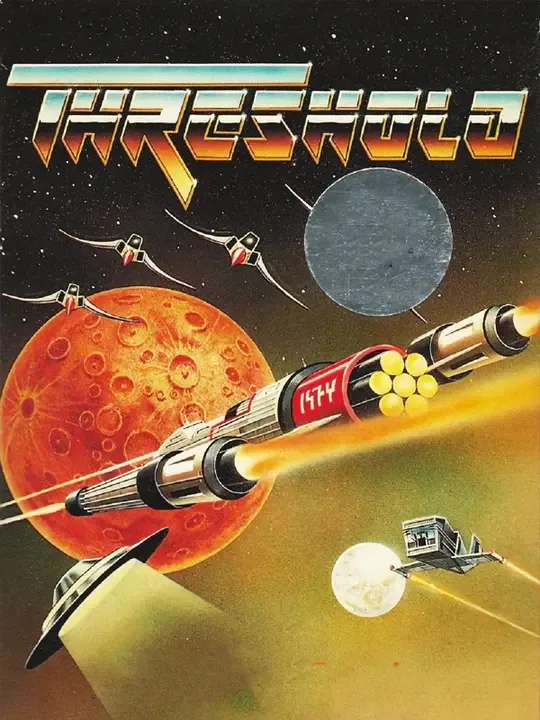
Threshold
Threshold is a typical shoot 'em up that places the player's spaceship at the bottom of the screen where he has to fend of the enemy. If the player misses an enemy and he reaches the opposite side of the screen he will reappear on the other side of the screen again. This goes on as long as the player has destroyed all enemy ships and the game progresses into the next stage with enemies approaching in a different attack pattern. Needless to say that contact with an enemy projectile or an enemy itself results in losing a life.
SCREENSHOTS
PHYSICAL
HISTORY
Threshold is a fixed shooter written by Warren Schwader and Ken Williams for the Apple II and published by On-Line Systems in 1981. Based on Sega's Astro Blaster arcade video game, Threshold introduces many enemy ship types and wave formations as the game progresses. Reviewers found the variety distinguished the game from similar shoot 'em ups.
Ports to other systems were released on ROM cartridge: Atari 8-bit computers and VIC-20 in 1981, Commodore 64 in 1983, and ColecoVision and Thomson computers in 1984. An Atari 2600 adaptation was published by Tigervision in 1982. It is unique in allowing the player's ship to move vertically.
Gameplay
The player moves a spaceship, the Threshold, left and right along the botton of the screen and uses its laser weapon to destroy waves of aliens attacking from above. When a wave is eliminated, another appears. As in Astro Blaster, firing the laser increases its temperature, and it cools when not in use. If the temperature bar fills completely, then the weapon is disabled until it fully cools. Once per ship, pulling back on the joystick activates a "warp drive" that briefly slows the action.
In the Atari 2600 conversion, the ship can be freely moved in eight directions in the lower portion of the screen, but lacks the warp drive ability.
Development
The game was inspired by Ken Williams playing an Astro Blaster arcade machine in a store and calling Warren Schwader. In an interview in Halcyon Days, Schwader said: Instead of trying to duplicate the game in every detail, I set out to just take the concept and run with it–after first playing Astro Blaster for hours on end though. No matter how hard we tried, we never could get to the end of that game. There were always more new creatures to discover and that kept us coming back. We set out to provide the same experience for Threshold players.
It took two months to implement. Williams only worked on the project for two weeks of that time, writing the Apple II animation routines.
Reception
On-Line Systems sold approximately 25,000 copies of Threshold.
Reviewing the Apple II original for Creative Computing, David Lubar wrote, "The animation in Threshold is superb", and he found the number of enemy types and waves to be a strong point. The magazine's Steve Williams said that the VIC-20 version "is a fine action game with a few interesting twists ... one of the best Galaxian derivatives available for the Vic". The Book of Atari Software 1983 gave the Atari 8-bit port a B rating: "It's the usual scenario, with this exception: the game offers unusual depth and variety." They found they sometimes mistook the stars in the animated background for enemy bullets. In Ahoy! magazine, R.J. Michaels led off his review with, "Only humor saves this game from being a run of the mill slide-and-shoot burn-the-alien-invaders game."
Appraising the Atari 8-bit computer version, Electronic Games noticed the Astro Blaster connection and wrote "The graphics in Threshold are tremendous." The reviewer disliked the loading that occurs every so often between levels and found the game overall too difficult.
Atari 2600
Tigervision's Atari 2600 adaptation received a "Certificate of Merit" in the "Best Science Fiction/Fantasy Videogame" category of the 1983 Arcade Awards. JoyStik magazine gave the 2600 version four out of five stars and wrote: "Finally, a bottom-shoot space game where you can move vertically, as well as horizontally!"
GAMEPLAY VIDEO
REVIEWS
Published elsewhere, collected here. Every score is the outlet's own, on the outlet's own scale. Follow the link for the full review.
“Threshold is a game that deserves to find an audience that will truly appreciate its provocative and philosophical approach and represents another excellent title in Critical Reflex's library. The opening credits claim that it is a true story and this detail in particular has lead me to speculate on possible metaphorical interpretations ranging from the highly personal to the global political. It is rare for a game to make you think quite this much and that is meant as high praise.”
“Threshold delivers a tense and immersive experience with resource management, branching endings, and PS1-inspired graphics. Though some elements can feel overly ambiguous, the game’s smart design and dark atmosphere make it a must-play for fans of psychological mysteries and unique storytelling.”
“Threshold takes a simple premise and runs with it, mixing a curious blood-soaked mystery with thin altitude air. The mystery of the ceaseless train atop the mountain peak is interesting to uncover, even if some of the gameplay systems try to get in the way at times. The train must run, just don’t look inside.”
“Short but powerfully unsettling, Threshold takes aim at the strange and horrifying helplessness of being a small cog in a giant corporate machine, and nails its execution brilliantly.”
“It's short, but Threshold will capture your attention straight from the off and keep you gripped until you reach one of its multiple conclusions. It can be repetitive at times, but the desire to unravel its mysteries will undoubtedly pull you through.”
“THRESHOLD is an interesting and creepy tale that succeeds in creating an intriguing tale, even if it has some minor issues here and there. The story is extremely entertaining, and I was taken aback throughout the game when I figured out what was going on. It is a bit short, and the gameplay is very basic, but it does the job and, with the fantastic visual style, complements the story which absolutely shocked me. I do wish the experience was a bit better with a controller and on the Steam Deck, and some optimization on both fronts would have helped a lot. It's still playable, but I wouldn't co”
“Threshold is interesting, but didn't captivate me in the ways that Mouthwashing did. It has an eerie charm to it, and the PSOne/Nintendo 64 visuals do a lot to give this a nice unique look among the tons of sprite-based indie games. It may be a short shift, but you'll always remember your brief stint as a member of the Border Post, just don't tell Mo.”
“While Threshold doesn't do too much to justify its short runtime, has a misleading genre label, and has a few bugs and glitches that may break your immersion, the overall experience is fantastic. The unique premise, addicting gameplay loop, and dreamlike visuals will have you hooked from beginning to end. Plus, thanks to its multiple endings, you'll likely be going back to Threshold over and over again to find out everything it has to offer.”
“As a whole, Threshold is a delightfully bizarre and engaging little game, but the odd pacing and structure might not be to everyone’s liking. The core main gameplay loop borders on tedious, and there’s a frustrating amount of bugs, however, it’s getting to the bottom of that mystery that makes it an utterly engaging experience. If you’re looking for weirdness, you should give this one a go.”
“Threshold has some interesting ideas but it very bare bones both in terms of gameplay and storyline.”
“Beneath its simple, minimalist exterior, Julien Eveillé’s work presents a searing dystopia that transforms the daily grind into a challenge capable of robbing us of even our last breath. It is a piece that conceals a powerful critique of industrial labor and personal sacrifice. It is frightening to think that something as basic as breathing becomes a commodity used to sustain a larger machine that consumes our lives and slowly silences us.”
Reviews are the work of the outlets named. Titles, scores and quoted excerpts are reproduced for identification and criticism; each links to the original.
SCORES
RELEASES 6 systems
PHYSICAL RELEASES 1 box
