
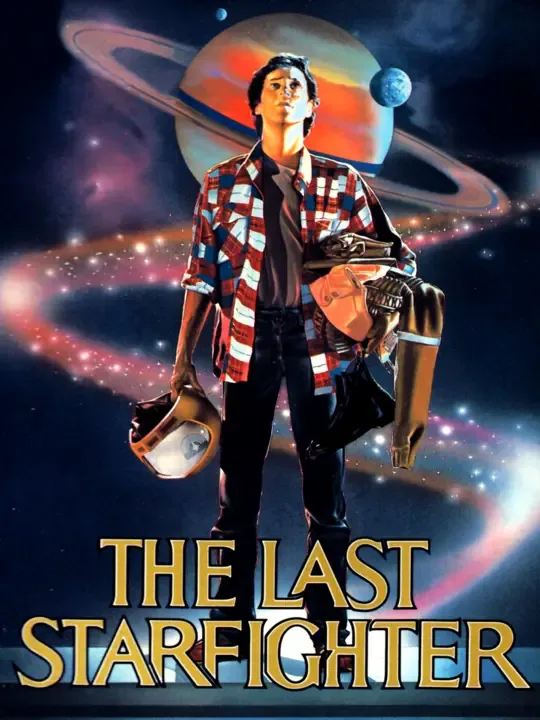
The Last Starfighter
The Last Starfighter is based on the 1984 movie of the same name. The hero must single-handedly pilot an extraordinarily powerful starfighter to destroy an enemy armada. The action takes place in outer space from a side-scrolling perspective where the ship always remains lined up in the middle of the screen but is able to turn forwards and backwards while accelerating and decelerating. The ship can also collapse into a slimmer configuration. Enemies come at you from all directions and in all formations. Shoot them as quickly as possible while also disabling the enemy fleet's starcruisers as best you can. The game also features a 2-player mode where each player takes turns fighting the armada.
SCREENSHOTS
HISTORY
The Last Starfighter is a 1984 American space opera film directed by Nick Castle. The film tells the story of Alex Rogan (Lance Guest), a teenager who, after winning the high score in an arcade game that's secretly a simulation test, is recruited by an alien defense force to fight in an interstellar war. It also features Dan O'Herlihy, Catherine Mary Stewart, and Robert Preston in his final role in a theatrical film. The character of Centauri, a "lovable con-man", was written with Preston in mind and was a nod to his most famous role as Professor Harold Hill in The Music Man (1962).
The Last Starfighter was released on July 13, 1984, by Universal Pictures. It earned $28.7 million at the domestic box office, against a budget of $15 million, and positive reviews from critics. The film, along with Walt Disney Pictures' Tron (1982), has the distinction of being one of cinema's earliest films to use extensive "real-life" computer-generated imagery (CGI) to depict its many starships, environments, and battle scenes. There was a subsequent novelization of the film by Alan Dean Foster, as well as a video game based on the production. In 2004, it was also adapted as an off-Broadway musical.
Plot
Teenager Alex Rogan lives in a trailer park with his younger brother Louis and their mother Jane. Aside from his girlfriend Maggie Gordon, his only diversion is an arcade game called Starfighter, in which the player is "recruited by the Star League to defend the Frontier against Xur and the Ko-Dan Armada" in deep-space warfare. One evening, Alex becomes the game's highest-scoring player. The moment is spoiled, however, when he learns that his application for a college scholarship has been rejected.
The inventor of Starfighter, Centauri, arrives in a futuristic car with a proposition. Centauri is a disguised alien, and his car is a spacecraft. Alex is taken to the planet Rylos while Beta, a doppelgänger android, covers his absence. Alex learns of a conflict between the peaceful Rylan Star League and the oppressive Ko-Dan Empire. The latter's armada, poised to invade Rylos, is led by Xur, a would-be-tyrant who has sabotaged the Frontier-forcefield shielding Rylos and other League-worlds from the Ko-Dan. The only hope against Xur and his allies rests with a small fleet of Gunstar spacecraft, operated by "Navigators" and by "Starfighter" gunners. Centauri's Starfighter arcade game is a recruiting tool designed to train Starfighters. Alex meets a friendly reptilian Navigator named Grig, to whom he explains his reservations about being part of the coming conflict.
Xur contacts Starfighter Command as Alex watches. After publicly executing a Star League spy, Xur promises the imminent fall of Rylos. Shaken, Alex asks to be taken home; there, Centauri gives him a means to contact the League should he change his mind. Back on Rylos, a saboteur disables Starfighter Command's defenses as the Ko-Dan command ship attacks with a long-range Meteor Gun. The remaining Starfighters and their Gunstars are wiped out. The saboteur warns Xur of Alex's escape.
Alex's life is saved by another twist of fate, when he discovers Beta and contacts Centauri to retrieve the droid. Centauri arrives just as Alex and Beta are attacked by a Zando-Zan, a shape-shifting assassin in Xur's service. Centauri is mortally wounded protecting Alex. He and Beta explain that more Zando-Zans are en route to Earth; Alex's only hope for survival is to embrace his calling as a Starfighter. Alex agrees, and Centauri flies him back to Starfighter Command just before dying from his injury. Alex and Grig take off in a custom-modified Gunstar.
While Grig mentors Alex, Beta finds it difficult to maintain his impersonation...particularly with Maggie. Then a second Zando-Zan shoots Beta in front of Maggie, revealing the ruse. Maggie tags along as Beta steals a truck and chases the Zando-Zan. Before the would-be-assassin can warn Xur, Beta sacrifices his life to destroy it.
Believing Alex has been slain, Xur orders the taking of Rylos. Then Alex and Grig ambush the Ko-Dan mothership. As Ko-Dan warlord Kril relieves Xur of command, Alex knocks out the mothership's communications and weapons-targeting system. Xur overpowers his captors and escapes. Outnumbered and overwhelmed by Ko-Dan fighters, Alex activates "Death Blossom": an experimental weapon, developed by Grig, which destroys the remaining fighters. His flagship's batteries still offline, Kril attempts to ram the Gunstar, which evades him. Alex disables Kril's navigation system, and the mothership crashes into a nearby moon.
Alex is proclaimed the savior of Rylos. Grig and a recovered Centauri persuade him to help rebuild the Rylan Starfighter legion. Alex and Grig stop by Earth, landing their Gunstar in the trailer park. Louis is delighted to meet Grig, who speaks of Alex's heroism. Alex bids his family farewell and invites Maggie along to Rylos. She agrees. Louis throws himself into mastering the Starfighter game so that he too can join the legion.
Cast
Production
Jonathan R. Betuel stated that the genesis for the film came about because he wandered into a video arcade and saw a young boy playing a video game. At that time, he was reading the book The Once and Future King by T. H. White. He wondered what would happen if a video game were a metaphorical sword in a stone, and a boy racked up an incredible score, which would cause a ripple effect across the universe.
The Last Starfighter was shot in 38 days, mostly night shoots in Canyon Country. It was one of the earliest films to make extensive use of computer graphics for its special effects. In place of physical models, 3D-rendered models were used to depict space ships and many other objects. The Gunstar and other spaceships were designed by artist Ron Cobb, who also worked on Dark Star, Alien, Star Wars and Conan the Barbarian.
Computer graphics for the film were rendered by Digital Productions (DP) on a Cray X-MP supercomputer. The company created 27 minutes of effects for the film. This was considered an enormous amount of computer generated imagery at the time. For the 300 scenes containing computer graphics in the film, each frame of the animation contained an average of 250,000 polygons and had a resolution of 3000 × 5000 36-bit pixels. Digital Productions estimated that using computer animation required only half the time and between a third to half of the cost of traditional special effects. The result was a cost of $14 million for a film that made close to $29 million at the box office.
DP used Fortran, CFT77 for programming:
Everything was in FORTRAN, because it was the only language with vectorization when we started and remained the only language with good vectorization through the life of DP.
Not all special effects in the film were done with computer animation. The depiction of the Beta unit before it had taken Alex's form was a practical effect, created by makeup artist Lance Anderson. The Starcar, created by Gene Winfield and driven by Centauri, was a working vehicle based on Winfield's Spinner designs from Blade Runner.
Because the test audiences responded positively to the Beta Alex character, director Nick Castle added more scenes of Beta Alex interacting with the trailer park community. Because Lance Guest had cut his hair short after initial filming had been completed and he contracted an illness during the re-shoots, his portrayal of Beta Alex in the added scenes has him wearing a wig and heavy makeup. Wil Wheaton had a few lines of dialogue that were ultimately cut from the film, but he still is visible in the background of several scenes.
Music
Composer Craig Safan wanted to go "bigger than Star Wars" and therefore used a "Mahler-sized" orchestra, resulting in an unusual breadth of instruments, including "quadruple woodwinds" and "eight trumpets, [trombones], and horns!"
Reception
At the box office, the film grossed over $28.7 million in the United States and Canada. On home video, the film grossed $13 million in video rentals by 1991.…
STORY
The plot essentially mirrors the events of the film.