
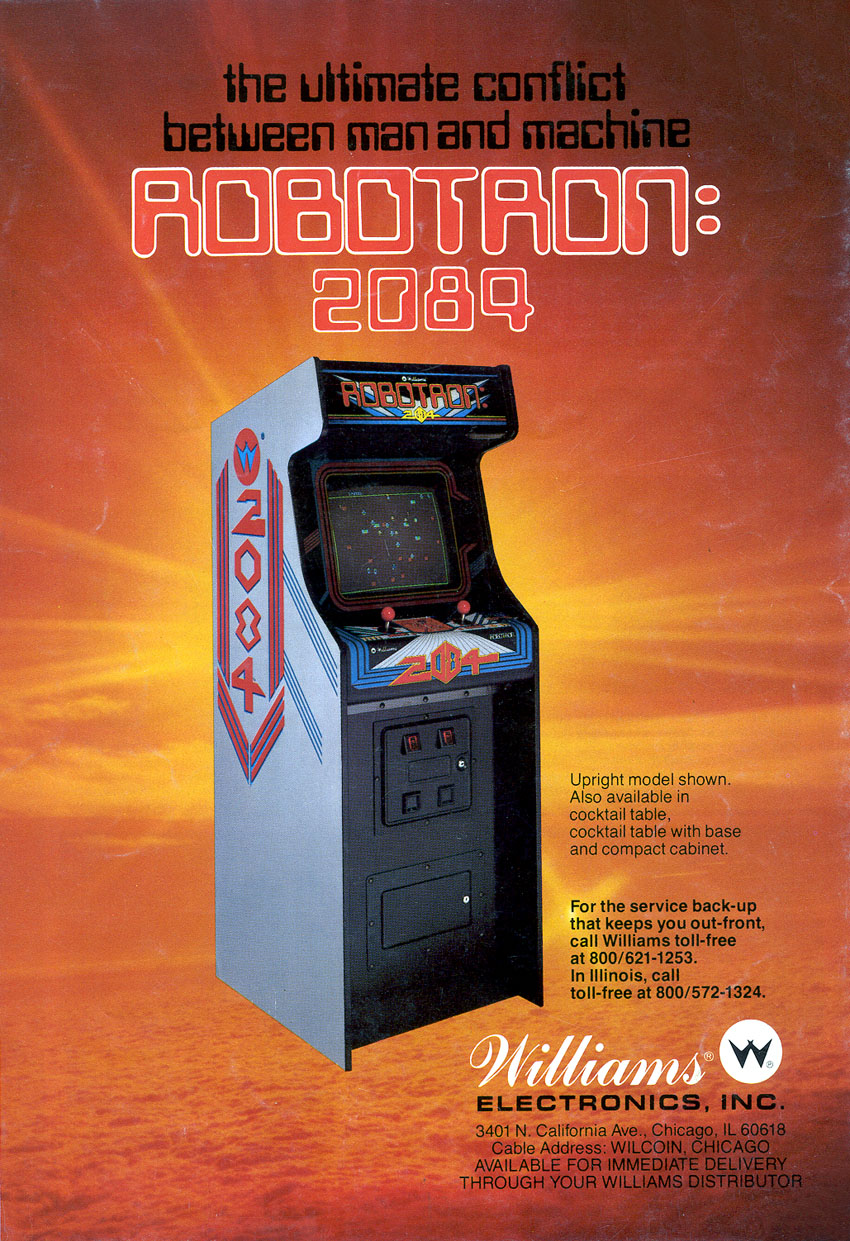
Robotron: 2084
In 2084, man creates a species of super-advanced cyborgs known as Robotrons. Recognizing the imperfect nature of their creators, the Robotrons conclude that the inefficient human race must be exterminated. In Robotron: 2084, only you and a single family of clones remain. If mankind is to survive, you must destroy the Grunts, Brains, Enforcers, and Tanks - but avoid the indestructible Hulks at all cost. Can you withstand wave after wave of android invasion and rescue Mommy, Daddy, and Mikey... before it's too late?
SCREENSHOTS
PHYSICAL
HISTORY
Robotron: 2084 (also referred to simply as Robotron) is a twin-stick shooter video game developed by Eugene Jarvis and Larry DeMar of Vid Kidz and released by Williams Electronics for arcades in 1982. The game is set in the year 2084 in a dystopian future where robots have turned against humans in a cybernetic revolt. The player's goals are to defeat endless waves of robots, rescue surviving humans, and earn as many points as possible.
Jarvis and DeMar drew inspiration from Nineteen Eighty-Four, Berzerk and Space Invaders when designing Robotron: 2084. The pair designed the game to instill panic in players by presenting them with conflicting goals and having many on-screen projectiles coming from multiple directions. A two-joystick control scheme was implemented to provide the player with more precise controls, and enemies with different behaviors were added to make the game challenging. Following its release in arcades, Atari ported the game to several home platforms in the 1980s. It was later included in many retro gaming collections.
Robotron was critically and commercially successful. Praise among critics focused on the game's intense action, control scheme, and colorful visuals. While its challenging gameplay proved popular, commentators acknowledged it catered to select players. Though not the first game with twin joystick controls, Robotron: 2084 is cited as the game that popularized it in the 1980s; the design later saw a resurgence in the 2000s. Jarvis used the same control scheme later in the 1990 Smash TV. Robotron was ported to numerous home systems, most of which lacked the arcade's control hardware. It is frequently listed as one of Jarvis's best contributions to the video game industry.
Gameplay
Robotron is a twin-stick shooter game in which the player controls the on-screen protagonist from a top-down perspective. The game uses a two-joystick control scheme; the left joystick controls the on-screen character's movement, while the right is used to fire the character's weapon in specific directions. Both joysticks allow for an input direction in one of eight ways. The game is set in the year 2084 in a fictional world where "Robotrons" have, after a robot uprising, eradicated most of the human race. The main protagonist is a super-powered genetically engineered mutant who attempts to save the last human family.
Each level, referred to as a "wave", is a single screen populated with a large number of various enemy robots and obstacles; types range from invincible giants to robots that manufacture other robots. Coming into contact with an enemy, projectile, or obstacle costs the player one life; more lives can be earned at certain point totals. Waves also include human family members, who can be rescued to score additional points, but certain robots can either kill them or transform them into enemies. Destroying all vulnerable robots allows the player to progress to the next wave; the cycle continues until all lives are lost.
Development
Robotron: 2084 was developed in six months by Eugene Jarvis and Larry DeMar, founders of Vid Kidz. Vid Kidz served as a consulting firm that designed games for Williams Electronics, whom Jarvis and DeMar had previously worked for. Under the working title Robot Wars, the pair used a Gimix 6809 computer to write the game's program in assembly language. Jarvis and DeMar playtested the game themselves and continually tweaked the designs as the project progressed. The game was designed to provide excitement for players; Jarvis described the game as an "athletic experience" derived from a "physical element" in the two-joystick design.
After spending 18 months working collectively on Defender and Stargate, the developers desired a new creative focus and chose robots. The game was first inspired by Stern Electronics' 1980 arcade game Berzerk and the Commodore PET computer game Chase. Berzerk is a shooting game in which a character traverses a maze to shoot robots, and Chase is a text-based game in which players lure text characters into obstacles. The initial concept involved a passive main character; the object was to force robots chasing the protagonist to collide with stationary, lethal obstacles. As they deemed the design too boring compared to other action titles on the market, the developers added shooting gameplay to provide more excitement. The shooting elements drew inspiration from the 1978 arcade game Space Invaders, which had previously inspired Defender, their first arcade game.
Though contemporary games began to use scrolling to facilitate larger levels, the pair chose a single screen to confine the action. Jarvis aimed to outdo the tension in Space Invaders as the aliens crowd the player. To instill panic in the player, the protagonist is initially placed in the center of the game's action and must deal with projectiles coming from multiple directions, as opposed to previous shooting games, such as Space Invaders and Galaxian, where enemies attack from a single direction. This made for more challenging gameplay, an aspect Jarvis took pride in.
The developers felt a rescue theme similar to Defender was needed to complete the game and added a human family as a method to motivate the player to earn a high score. The additional aspect forced the player to constantly reevaluate their situation to choose the optimal action: avoid enemy attacks to survive, defeat enemies to progress, and save the family to earn points. Inspired by George Orwell's Nineteen Eighty-Four, Jarvis and DeMar incorporated an Orwellian world into the plot. Since the year 1984 was approaching, they decided to set the game a century into the future to provide a more realistic time frame for their version of "Big Brother". Jarvis, a science fiction fan, based the Robotrons on the idea that computers would become advanced entities that helped humans in everyday life. He believed the robots would eventually realize that humans are the cause of the world's problems and revolt against them.
The pair placed enemies in different groups throughout the stages to create themes. Early stages are designed to be relatively simple compared to later ones. The difficulty level is designed to increase quickly so players would struggle to complete later stages. In retrospect, Jarvis attributed his and DeMar's average player skills to the game's balanced design. Though they made the game as difficult as they could, the high end of their skills proved to be a good challenge for expert players. The graphics have a simple appearance to avoid a cluttered game screen, and object designs were made distinct from each other to avoid confusion. They chose black as the background color to help characters stand out visually and further reduce clutter.
=== Enemy designs ===…
1CC RUNS
One-credit clears we point to as the benchmark for this game.
GAMEPLAY VIDEO
SCORES
ACHIEVEMENTS 1 set
Tracked by RetroAchievements and earned in an emulator that reports to it. A game tracked on more than one machine gets a set for each, because they are different lists earned on different hardware.