
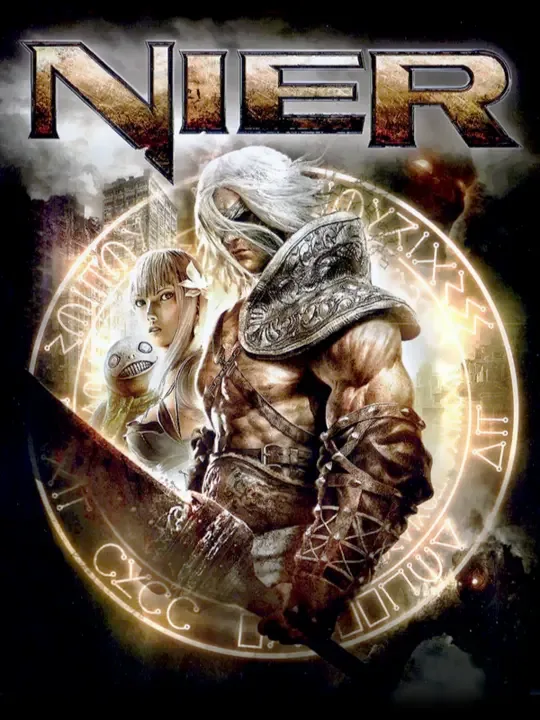
NieR
Nothing is as it seems in Square Enix's latest action adventure game, set in a crumbling world plagued by disease and dark, unrecognizable creatures. Players assume the role of the unyielding protagonist, NIER, resolute in his quest to discover a cure for his daughter, who is infected with the Black Scrawl virus. With powerful allies and a mysterious book, NIER encounters things that will confound even the mightiest of warriors. With NIER, experience seamless in-battle cinematics and explore hauntingly familiar lands, intense action-packed battles, and storytelling like only Square Enix can do
SCREENSHOTS
PHYSICAL
HISTORY
Nier is a 2010 action role-playing game developed by Cavia and published by Square Enix for the PlayStation 3 and Xbox 360. In Japan, the game was released as Nier Replicant for the PlayStation 3 with a younger main character, while an alternative version titled Nier Gestalt with an older main character was released for the Xbox 360; Gestalt was released outside Japan as Nier for both platforms. A remaster of the Replicant version called Nier Replicant ver.1.22474487139... was released internationally for PlayStation 4, Xbox One, and Windows in 2021.
The game is a spin-off from the Drakengard series, following the fifth ending of the first game, the events of which have left Earth in ruin. Set over a thousand years later, the story follows the player-named protagonist attempting to find a cure for a terminal illness afflicting a young girl named Yonah. The gameplay borrows elements from various video game genres, occasionally switching between them and the main role-playing-based gameplay.
Beginning production in 2007, the game was directed by Drakengard creator Yoko Taro, who was given a lot of creative freedom with the project. Its storyline drew inspiration from the September 11 attacks and the war on terror, while its gameplay was partly inspired by the God of War series. Due to feedback outside of Japan, multiple versions of the protagonist were created. The music was composed by Monaca, a music studio founded by Keiichi Okabe, with several albums being released.
Nier was released to mixed reception; reviewers praised the story, characters, and soundtrack and were mixed in their opinions of how well the disparate gameplay elements were connected. The execution of some gameplay elements was criticized, notably the side quests, and the graphics were regarded as substandard. Despite this, the game acquired acclaim among players over time, becoming a cult classic. The 2021 remaster was released to positive reception, with praise for the graphical and gameplay improvements. The original Nier sold 500,000 copies, while the updated version sold over 2 million copies worldwide. A sequel developed by PlatinumGames, titled Nier: Automata, was released in 2017.
Gameplay
Nier is an action role-playing game in which players take on the role of a player-named protagonist; the protagonist is a middle-aged man in Nier Gestalt and a teenage boy in Nier Replicant, named by the player. The player directly controls the main character through a third-person perspective to interact with people, objects, and enemies throughout the game. The player can turn the camera around the characters, which allows for a 360° view of the surroundings. The three-dimensional world is divided into areas separated by loading screens, and the player can move freely throughout these areas by walking, running, jumping, and climbing ladders. In some rooms and buildings, the camera swings to the side, and the main character is restricted to moving as in a two-dimensional platforming environment, while during certain battles, the camera pulls up to simulate a top-down shoot 'em up or other video game genres.
While traveling the player is frequently attacked by monsters, which include shadowy figures called Shades, large animals, and robots. Defeating these enemies gives the player experience points that can increase the main character's power and money that can be used to purchase items. The player's weapons can be customized to have greater damage and abilities using materials that can be purchased, dropped from monsters, or scavenged around the world. Multiple varieties of each weapon type can be acquired. The player can also use magic spells, which require enough energy from a constantly regenerating amount to cast. These spells include projectiles and large shadowy fists, among others; new spells are acquired in the first half of the game by completing specific battles. In addition to the main plotline, Nier includes numerous sidequests, which give the player experience points and money, as well as fishing and farming segments.
Synopsis
In the mid 21st century, in the midst of a snowstorm in summer amid a ruined city, the protagonist fends off ethereal black monsters to protect a sick young girl named Yonah. The protagonist uses a magical book to fend off the creatures, but Yonah touches it and is covered in black markings, worsening her condition. The story moves to over a thousand years later, with the current feudal civilization in decline and the black creatures—dubbed Shades—becoming more hostile. The protagonist and Yonah live in a village built within post-industrial ruins, with the protagonist taking odd jobs from the village leaders, twin sisters Devola and Popola, to earn money to support the sick Yonah. While rescuing Yonah from a temple after she wanders there looking for a rare flower, the protagonist meets the talking book Grimoire Weiss, which suggests that the two team up to use Weiss's magic and to find a cure for Yonah's disease, identified as the terminal Black Scrawl. In their search, they encounter Kainé, a hot-tempered and foul-mouthed swordswoman, and Emil, a blindfolded boy whose eyes petrify anyone they see. After journeying for a time, the protagonist's village is attacked by a giant Shade. The battle ends with Emil being forced to petrify Kainé to seal the shade, and Yonah being kidnapped by a master Shade dubbed the Shadowlord.
The game jumps forward five years, with the situation worsening. The protagonist and Emil successfully find the power necessary to free Kainé and kill the giant Shade, but getting the power transforms Emil into a skeletal being the villagers fear. Under Devola's and Popola's guidance, the party seeks parts of a stone key that will unlock a pathway to the Shadowlord. After defeating five Shades and assembling the key, the team goes to defeat the Shadowlord. Devola and Popola then confront the party, revealing themselves to be allied with the Shadowlord in the name of a greater plan. 1300 years prior, humanity faced extinction due to an incurable disease. In an attempt to survive, they separated their souls from their bodies; the current humans are artificial Replicant bodies who developed their own personalities, while the Shades are human souls—dubbed Gestalts—who are slowly losing their minds through being unable to reunite with their bodies. The Black Scrawl is a side effect of the Gestalts' insanity degrading their Replicant counterparts. The Shadowlord is the prime Gestalt used to stabilize them, and Devola and Popola are androids who oversee the system. The party defeats the twins, with Emil sacrificing himself in the process. The remaining group then defeats the Shadowlord, revealed to be the Gestalt of the prologue's protagonist, with his actions driven by the wish to save his Yonah by reuniting her Gestalt and Replicant. Though successfully rejoined, the Gestalt Yonah dissipates to save her Replicant version's life, and after Grimoire Weiss sacrifices himself to weaken the Shadowlord's power, the protagonist kills him.
If the player enters further playthroughs, events start just after Kainé is freed. Kainé's past is focused on, showing the discrimination she suffered due to her parents' deaths, being born intersex, and later being partially possessed by the rogue Gestalt Tyrann. Through Tyrann, the player can understand the previously garbled speech of Gestalts. New story sequences show the Gestalt antagonists' motivations and backstory, showing them to be sentient and fighting for their own beliefs and goals. The second ending shows the spirit of the Gestalt protagonist and Yonah reuniting in the afterlife and reveals that Emil survived; further information confirms that the Shadowlord's death will lead to humanity's extinction as Replicants and Gestalts can no longer be rejoined. In a third or further playthrough, Kainé becomes overwhelmed by Tyrann, going berserk and forcing the protagonist to fight her. The protagonist can either kill her to end her suffering (the third ending) or sacrifice his life for her (the fourth ending). The latter choice erases memory of him from Kainé and Yonah and deletes all of the player's save data.
The updated version of Replicant adds a fifth ending after a new game is begun following the fourth ending, beginning after the defeat of Kainé's Shade nemesis Hook. Three years after the Shadowlord's defeat, Kainé continues having nightmares about losing something precious and fights increasingly hostile Shades. Investigating a settlement, she finds its people killed by robots emerging from its central tree, the control unit recording Replicant memories. Kainé is talked to by the control unit's AI through twin childlike avatars. She is aided in battling machine duplicates of her by Emil, eventually entering the tree's mainframe and battling enemies drawn from her memories. She ultimately battles a more powerful Hook, helped by the data remains of Grimoire Weiss.…
STORY
The game opens with a prologue during the summer of 2049 in a snowstorm. In a modern, broken-down grocery store, Nier (Jamieson Price) fends off attacks from ethereal monsters to protect his sick young daughter, Yonah (Heather Hogan). After defeating the monsters, he checks on Yonah, who has begun to cough badly. The game then cuts to 1,312 years later, where the player sees what appears to be the same two characters, now living in a village built upon the ruins of an old town. The low-technology village is one of several, and is surrounded by more modern ruins such as the remnants of train tracks and industrial machinery. The areas between towns are filled with monsters known as Shades that attack travelers.
As Yonah's illness, the Black Scrawl, is terminal, Nier sets out to look for a cure. As he does, Nier finds a talking book, Grimoire Weiss (Liam O'Brien), which suggests that the two team up to use Weiss' magic and to find a cure for Yonah's disease. In their search, they encounter Kainé (Laura Bailey), a hot-tempered and foul-mouthed swordswoman; and Emil (Julie Ann Taylor), a blindfolded boy whose eyes petrify anyone they see. After journeying for a time, the village is attacked by a giant shade; the battle culminates in Yonah being carried away by a master Shade that suddenly appears—the Shadowlord—who carries his own book, Grimoire Noir.
The game then jumps five years forward. Nier and the others are trying to find the parts to a key that they believe will help them locate the Shadowlord and Grimoire Noir. After defeating five Shades and assembling the key, the team go to defeat the Shadowlord. There, Devola and Popola (both voiced by Eden Riegel), characters who have been guiding Nier on his quest, appear to try to stop them. They explain that over 1300 years prior, humanity faced extinction due to an incurable disease. In an attempt to survive, they separated their souls from their bodies using Grimoire Noir and Weiss. They created clones resistant to the disease, Replicants, and intended to recombine the souls, or Gestalts, with the Replicant bodies once it had died out; Devola and Popola were androids set to oversee the project. Over time, the Replicants had begun to form their own identities; while the Gestalts, or Shades, had grown aggressive to them.[7]
Nier defeats the pair, with Emil sacrificing himself to ensure his friends' progress. The remaining group then defeats the Shadowlord, and the player discovers that he is the Gestalt form of the Nier from the prologue. Driven to protect his Yonah, he was the first Gestalt and has combined her with the Replicant Yonah. The original Yonah, however, tells the Gestalt Nier that she can hear the new Yonah inside her, and that she loves the Replicant Nier and deserves the body just as much.[8] She vacates the body, and Nier and Yonah are reunited.
If the player plays the game again, they start just after the five-year skip. They learn about Kainé's past, including that she is intersex, which along with the death of her parents resulted in her ostracism as a child, and that she is partially possessed by a Shade. The player gains the ability to understand what the shades are saying, including the one possessing Kainé, though in-game Nier, Weiss, and Emil are still unable to. Additional cutscenes are also shown, giving the motivations and backstory behind the Shade bosses that are fought and showing them as sentient people trying to defend their friends against Nier. The ending to the second playthrough shows that Emil survives his sacrifice, and that Gestalt Nier and Yonah are reunited in the afterlife. A third playthrough presents the player with a choice in the ending to save Kainé, who is seen to be dying in agony; Nier can either kill her to end her suffering, or sacrifice his life for her. The latter choice not only erases all memory of him from the other characters' minds, shown in a final cutscene, but also deletes all of the player's saved progress, as if the game had never been played. Moreover, if the player wants to start a new game, they will be unable to enter the same name chosen for the previous playthrough for the Nier character.
GAMEPLAY VIDEO
TRAILERS
SCORES
RELEASES 4 systems
PHYSICAL RELEASES 1 box
