
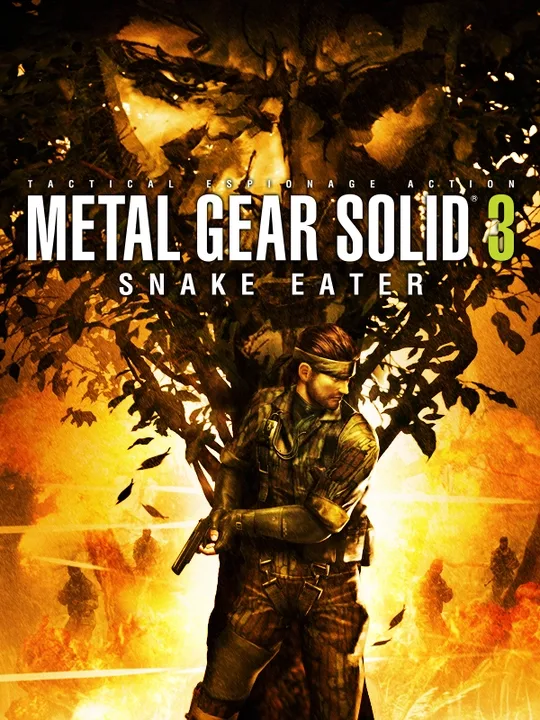
Metal Gear Solid 3: Snake Eater
Metal Gear Solid 3: Snake Eater is the prequel to the entire Metal Gear series. Most of the series' defining gameplay elements have been carried over and as before, Snake must use stealth and wits rather than brute force to infiltrate enemy zones and eliminate his major adversaries. Unlike the previous games, this installment takes place in a large outdoor jungle. Snake is able to use camouflage, climb trees, hide in tall grass or wear clothes that make him less noticeable.
SCREENSHOTS
PHYSICAL
HISTORY
Metal Gear Solid 3: Snake Eater is a 2004 action-adventure stealth game developed and published by Konami for the PlayStation 2. It was released in late 2004 in North America and Japan, and in early 2005 in Europe and Australia. Written, produced and directed by Hideo Kojima, the game is the fifth mainline installment in the Metal Gear series and the first chronologically, serving as a prequel to the entire series. Set in 1964, 31 years before the events of the original Metal Gear, the story centers on the FOX operative codenamed Naked Snake as he attempts to rescue Russian rocket scientist Nikolai Stepanovich Sokolov, sabotage an experimental superweapon, and assassinate his defected former mentor.
While previous games were set in a primarily urban environment, Snake Eater adopts a 1960s Soviet jungle setting, with the high-tech, near-future trappings of previous Metal Gear Solid games replaced with wilderness. While the environment has changed, the game's focus remains on stealth and infiltration, while retaining the series' self-referential, fourth-wall-breaking sense of humor. The story of Snake Eater is told through numerous cutscenes and radio conversations.
Considered one of the greatest video games of all time, Metal Gear Solid 3 was met with critical acclaim, with many considering it an improvement over its predecessor, Metal Gear Solid 2: Sons of Liberty. Critics praised the narrative, characters, survival elements, and graphics, but some of the new gameplay mechanics and dated camera system were met with a more mixed reaction. Subsequently, the later Subsistence version of the game would be praised for rectifying these issues. The game was also a commercial success, selling more than four million copies worldwide, albeit less than Sons of Liberty.
An expanded edition, titled Metal Gear Solid 3: Subsistence, was released in Japan in late 2005, then in North America, Europe and Australia in 2006. A remaster was included in the Metal Gear Solid HD Collection, which was rereleased in the Metal Gear Solid: Master Collection Vol. 1 compilation on October 2023. A remake, Metal Gear Solid Delta: Snake Eater, was released in August 2025. A numbered sequel, Metal Gear Solid 4: Guns of the Patriots, was released in 2008, while a narrative sequel, Metal Gear Solid: Peace Walker, was released in 2010.
Gameplay
The gameplay of Snake Eater is similar to that of previous games in the Metal Gear Solid series. Snake, controlled by the player, must move undetected through a hostile, enemy-filled environment. Although Snake acquires various weapons (ranging from handguns to rocket-propelled grenades), the emphasis is on using stealth to avoid confrontations. Many objects and gadgets can be found along the way to aid in this, including motion detectors to track hostile soldiers, and the Metal Gear series' trademark cardboard box, which Snake can hide under to avoid visual detection.
Despite the fundamental similarities, Snake Eater introduces many new aspects of gameplay not present in previous Metal Gear games, including camouflage, a new hand-to-hand combat system called "close quarters combat" or "CQC", a stamina gauge, and an injury-and-treatment system.
Two-thirds of the game is set outdoors in a Soviet tropical forest, and using the environment to its fullest potential is often the key to success. Of the new features, particular emphasis is placed on camouflage and using the jungle environment itself (for example, climbing trees or hiding in tall grass) to avoid being seen by the enemy. The advanced radar from previous games has been removed in favor of a simple motion detector and sonar system more suitable for the game's setting.
A percentage value called the "camouflage index" gauges Snake's exposure, on a scale from negative values (highly visible and attracting attention) up to 100% (completely invisible to the enemy). To minimize visibility, the player must switch between different camouflage uniforms and face paints to blend in with the environment; for example, wearing a bark-patterned uniform while leaning against a tree, or wearing striped face paint while hiding in tall grass. Other devices for camouflage, such as a fake gavial head to decrease chances of being detected in water, or a monkey mask, are also available.
The basic close combat from previous installments has been heavily refined and expanded into the CQC system. When unarmed or using a one-handed weapon, Snake can grab opponents and put them in a chokehold, at which point a variety of actions can be performed, such as choking the enemy unconscious, throwing the guard to the ground, slitting the enemy's throat, or interrogating them at knifepoint to obtain information. The context, the pressure applied to the button, and movement of the analog stick determine the action performed.
While previous games used only a simple life bar, Snake Eater keeps track of injuries over the entire body. For example, a long fall could fracture Snake's leg, lowering his maximum life until the injury either heals by itself over time, or is healed instantly through treatment with a splint and bandage.
Besides the aforementioned features, there is also the need to rely upon native flora and fauna to survive. This is manifested in a stamina gauge which constantly depletes during gameplay. Failure to restore the gauge by eating has detrimental effects on gameplay, such as decreasing Snake's ability to aim his weapon and being heard by the enemy due to Snake's loud stomach grumbles. Food can be stored in the backpack until it is needed. However, some types of food rot over time, and consuming rotten foods may result in Snake developing a stomachache, causing the stamina gauge to deplete faster.
The PlayStation 2 version of Snake Eater include a minigame titled "Snake vs. Monkey", a crossover with Sony Computer Entertainment's Ape Escape series in which Snake has to catch monkeys. In addition to containing tongue-in-cheek humor associated with both series, bonus items usable in the main game can be unlocked by progressing through various stages.
Synopsis
Setting
Snake Eater takes place in an alternate history of events, set within the Cold War during the 1960s. The game's story acts as a prequel to the entire Metal Gear series, exploring the origins of several events covered by previous games, as well as being the first chronological chapter in an overarching story following Big Boss.
Characters
The protagonist of Snake Eater, Naked Snake (David Hayter/Akio Ōtsuka), known as Big Boss in subsequent games, is a young former Green Beret assigned to the CIA unit FOX. During his mission, Snake is assisted by fellow FOX members over his radio: Major Zero (Jim Piddock/Banjō Ginga), commander of FOX and a former member of the British Special Air Service (SAS), who provides Snake with mission advice and battle tactics; Para-Medic (Heather Halley/Houko Kuwashima), who provides medical information, as well as advice on flora and fauna; and Sigint (James C. Mathis III/Keiji Fujiwara), who provides weapon and equipment information.
The two primary antagonists of the game are Colonel Volgin (Neil Ross/Kenji Utsumi), an electricity-controlling GRU colonel and member of the extreme Brezhnev faction, who are attempting to overthrow Nikita Khrushchev to seize power for Leonid Brezhnev and Alexei Kosygin, and The Boss (Lori Alan/Kikuko Inoue), former mentor to Naked Snake and co-founder of the FOX unit. The Cobra Unit, a Special Forces unit led by The Boss, is composed of The End (J. Grant Albrecht/Osamu Saka), a venerable expert sniper credited as the "father of modern sniping"; The Fear (Michael Bell/Kazumi Tanaka), who has supernatural flexibility and agility; The Fury (Richard Doyle/Masato Hirano), a disfigured former cosmonaut armed with a flamethrower and a jetpack; The Pain (Gregg Berger/Hisao Egawa), who can control hornets to both defend himself and attack his enemies; and The Sorrow (David Thomas/Yukitoshi Hori), the spirit of a deceased medium.
Other characters include Dr. Sokolov (Brian Cummings/Naoki Tatsuta), a rocket scientist whom Snake must rescue; rival scientist Aleksandr Granin (Jim Ward/Takeshi Aono); EVA (Jodi Benson/Misa Watanabe), Snake's love interest, American defector, and KGB agent sent to assist him, and a young Ocelot (Josh Keaton/Takumi Yamazaki), commander of the elite Ocelot Unit within Volgin's GRU.
=== Plot ===…
STORY
At the height of the Cold War, America's greatest agent known as The Boss defects to the Soviet Union. At the same time, an extremist named Colonel Volgin fires an American-made portable nuclear missile at the Soviet design bureau OKB-754, sparking an international incident. In order for America to clear its name and avoid World War III, a man named John and codenamed Naked Snake is dispatched by the special forces unit FOX to assassinate the woman who taught him everything.