
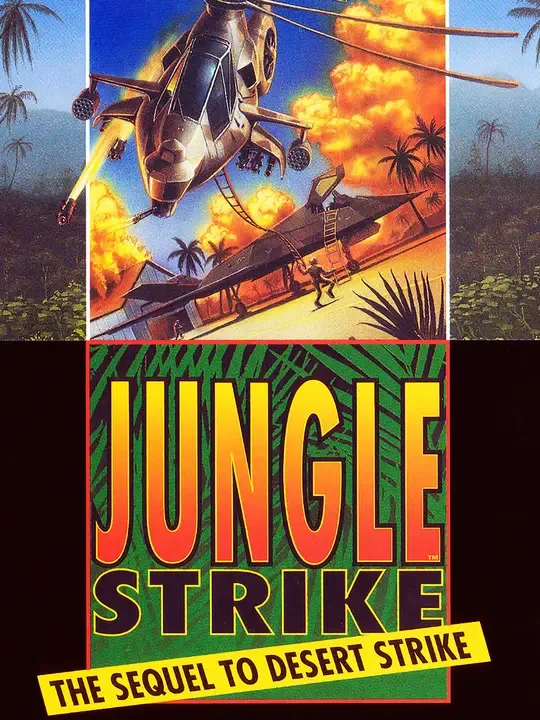
Jungle Strike
A sequel to Desert Strike: Return to the Gulf (a best-seller released the previous year) and the second instalment in the Strike series. Jungle Strike retained its predecessor's core mechanics and expanded on the model with additional vehicles and settings. The game was well received by most critics upon release, with the Mega Drive release receiving critical acclaim from their respective reviewers. Publications praised its gameplay, strategy, design, controls and graphics, although there were some complaints regarding the interface and difficulty.
SCREENSHOTS
PHYSICAL
HISTORY
Jungle Strike is a video game developed and published by Electronic Arts in 1993 for the Sega Genesis. The game was later released on several other consoles such as the Super Nintendo Entertainment System (SNES), and an upgraded version was made for DOS computers. The Amiga conversion was the responsibility of Ocean Software while the SNES and PC DOS versions were that of Gremlin Interactive, and the portable console versions were of Black Pearl Software. It is the direct sequel to Desert Strike (a best-seller released the previous year) and is the second installment in the Strike series. The game is a helicopter-based shoot 'em up, mixing action and strategy. The plot concerns two villains intent on destroying Washington, D.C. The player must use the helicopter and occasionally other vehicles to thwart their plans.
Its game engine was carried over from a failed attempt at a flight simulator and was inspired by Matchbox toys and Choplifter. Jungle Strike retained its predecessor's core mechanics and expanded on the model with additional vehicles and settings. The game was well received by most critics upon release. Publications praised its gameplay, strategy, design, controls and graphics.
Plot
Jungle Strike features two antagonists: Ibn Kilbaba, the son of Desert Strike's antagonist, and Carlos Ortega, a notorious South American drug lord. The opening sequence depicts the two men observing a nuclear explosion on a deserted island, while discussing the delivery of "nuclear resources" and an attack on Washington D.C.; Kilbaba seeks revenge for his father's death at the hands of the US, while Ortega wishes to "teach the Yankees to stay out of my drug trade".
The player takes control of a "lone special forces" pilot. The game's first level depicts the protagonist repelling terrorist attacks on Washington, D.C., including the President's limousine. Subsequent levels depict counter-attacks on the drug lord's forces, progressing towards his "jungle fortress". In the game's penultimate level, the player pursues Kilbaba and Ortega to their respective hideouts before capturing them.
The final level takes place in Washington, D.C. again, where the two antagonists attempt to flee after escaping from prison. The player must eliminate both Kilbaba and Ortega and stop four trucks carrying nuclear bombs from blowing up the White House. The PC version also extends the storyline with an extra level in Alaska, where the player must wipe out the remainder of Ortega's forces under the command of a Russian defector named Ptofski, who has taken control of oil tankers and is threatening to destroy the ecosystem with crude oil if his demands are not met. Once all levels are complete, the ending sequence begins and depicts the protagonist and his co-pilot in an open-topped car in front of cheering crowds.
Gameplay
Jungle Strike is a helicopter-based shoot 'em up, mixing action and strategy. The player's main weapon is a fictionalised Comanche attack helicopter. Additional vehicles can be commandeered: a motorbike, hovercraft and F-117. The latter in particular features variable height and unlimited ammunition, but is more vulnerable to crashes. The game features an "overhead" perspective "with a slight 3D twist". The graphics uses a 2.5D perspective which simulates the appearance of being 3D.
Levels consist of several missions, which are based around the destruction of enemy weapons and installations, as well as rescuing hostages or prisoners of war, or capturing enemy personnel. The helicopter is armed with machine guns, more powerful Hydra rockets and yet more deadly Hellfire missiles. The more powerful the weapon, the fewer can be carried: the player must choose an appropriate weapon for each situation. Enemy weapons range from armoured cars to artillery and tanks.
The player's craft has a limited amount of armour, which is depleted as the helicopter is hit by enemy fire. Should armour reach zero, the craft will be destroyed, costing the player a life. The player must outmanoeuvre enemies to avoid damage, but can replenish armour by means of power-ups or by airlifting rescued friendlies or captives to a landing zone. Vehicles have a finite amount of fuel which is steadily depleted as the level progresses. Should the fuel run out, the vehicle will crash, again costing the player a life. The craft can refuel by collecting fuel barrels. Vehicles also carry limited ammunition, which must be replenished by means of ammo crates.
Development and release
Jungle Strike is the sequel to Desert Strike, a similar game which parodied the Gulf War and which was released in 1992. Desert Strike arose from a failed attempt at a flight simulator and was inspired by Matchbox toys and Choplifter. Central to the game's concept were nonlinear gameplay and the eschewing of power-ups and bosses. With the success of the original title, game director John Manley and associate producer Tony Barnes were tasked with creating the sequel. Together with project manager Susan Manley they crafted an expanded game with an opening movie and were Electronic Arts first ever 16 Megabit cartridge. Producer Scott Berfield joined the group when the project was Alpha. Jungle Strike retained the core mechanics of its predecessor, with the addition of various vehicles and settings. Desert Strike was at the time Electronic Arts' highest selling video game and maintained a high sales chart position as Jungle Strike was released in 1993.
The Amiga conversion of Desert Strike featured upgraded graphics and sound over the Mega Drive original. With regards to the Jungle Strike Amiga conversion, senior programmer Stuart Johnson stated he "tried to keep this conversion a lot more faithful to the Mega Drive version than Desert Strike was". He attempted to make the Amiga conversion run more smoothly than the Mega Drive original. Graphical improvements were attempted: these were less successful on the A500 than the A1200 because of technical restrictions. The developers also struggled with technical challenges because of differences in hardware between the Mega Drive and Amiga. Amendments were also made to the workings of in-mission plot screens. The Amiga conversion was released as sequel Urban Strike was published for the Mega Drive in 1994.
DOS CD-ROM version includes full motion video cut scenes at introduction, between stages, and ending.
Jungle Strike was followed by three further sequels: Urban Strike, Soviet Strike, and Nuclear Strike. As the series moved to more advanced consoles, series creator Mike Posehn became less involved in the programming side of development. Urban Strike, released for the Mega Drive, featured new vehicles and locations, as well as on-foot sections. Soviet Strike, released for Sony's PlayStation and the Sega Saturn in 1996, featured 3D graphics, as did Nuclear Strike, released on PC and PlayStation in 1997 and the Nintendo 64 in 1999. Another sequel provisionally titled Future Strike was planned, but the game was eventually released as Future Cop: LAPD, a mech-based shooter game.
== Reception ==…
SCORES
ACHIEVEMENTS 1 set
Tracked by RetroAchievements and earned in an emulator that reports to it. A game tracked on more than one machine gets a set for each, because they are different lists earned on different hardware.
RELEASES 8 systems
PHYSICAL RELEASES 1 box
