
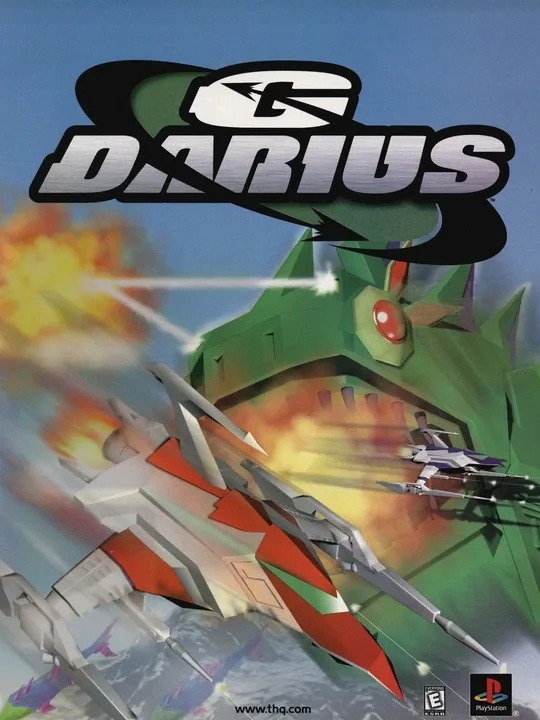
G-Darius
G-Darius is a shoot'em up arcade game, released by Taito in 1997. It is the fourth arcade installment of the Darius series and the first in the entire series to feature three-dimensional polygonal graphics. Much like previous installments in the Darius series, G-Darius is a two-dimensional horizontally scrolling shoot'em up set in a fictional future.
SCREENSHOTS
PHYSICAL
HISTORY
G-Darius is a horizontally scrolling shooter arcade video game released by Taito in 1997. It is the fourth arcade installment of the Darius series and the first with three-dimensional polygonal graphics. A port to the PlayStation was published as G Darius.
Gameplay
Much like previous installments in the Darius series, G-Darius is a horizontally scrolling shooter. While the game uses three-dimensional polygonal graphics, the gameplay is two-dimensional. The player controls a spaceship named the Silver Hawk and must battle enemies and avoid obstacles throughout the game's stages (referred to as "zones" in the game). The ship is armed with forward-firing missiles, small aerial bombs, and a protective force field. These can be upgraded by power-ups, in the form of large orbs, that are dropped by specially-colored enemies when they are destroyed. When the player reaches the end of a zone, a boss appears, which must be defeated to proceed. Once the boss of a zone is destroyed, the player is given a choice of which zone to play next via a branching path. There are 15 zones in total, numbered using the Greek letters alpha to omicron, but the player only needs to complete five in a row to reach one of five alternative endings. Each level also has two alternative routes that the player can choose about halfway through. Some of these are duplicated in later stages but result in the bosses appearance and attack sequences being slightly different.
Among the player's arsenal is the 'capture ball', which the player can launch to capture enemies. Once captured, the enemy will follow and aid the player's ship. Each enemy contains a unique enhancement; some will act as extra turrets and others will act as shields. Additionally, the player can detonate their captured enemy as a bomb. The captured enemy will continue to follow the player until either they are destroyed after taking enough damage, the player's ship is destroyed or the player 'absorbs' them to utilize a special ability.
New to the series is beam-dueling. The player can absorb a captured enemy to fire a powerful laser beam over a short period, which will instantly destroy nearly every enemy it comes into contact with. This is primarily used during boss fights. Every major boss in the game has an equivalent laser beam. If the player and the boss fire their lasers simultaneously, a 'duel' between the two will initiate. The player must overwhelm the boss' laser by repeatedly tapping the fire button as quickly as possible. If successful, the boss' beam will eventually dissipate and the player's beam will multiply in size (as well as in power) and severely damage, if not kill, the boss. Some bosses have multiple beams and if the player counters all of them, their own beam can multiply up to four times. Some enemies and large bullets are invulnerable to the beam, allowing bosses to shield themselves. Familiarity with a boss's attack patterns is thus vital for the successful use of the beam dueling mechanic.
An upgraded version of the game, G-Darius Ver. 2, added a beginner mode in which the player's power-up level goes down only one rank upon death, and the game ends after completing only 3 zones.
Plot
G-Darius is a prequel story that revolves around a conflict between the humanoids of Amelia and cyborg/chimera biovessels known as the "Thiima" (meant to mean simply "deliverer of death"). The Thiima had been aroused by the Amnelian army's use of the weapon A.N. (All-Nothing) to annihilate the world Blazer, whom Amelia had been at war with over jurisdiction over the moon Mahsah. Determined to protect their existence, and long ago programmed to protect the universe from just such threats as A.N., the Thiima swarmed Amelia. Although the armed forces were badly ravaged, Amnelian scientists and engineers were able to make use of both A.N. and reverse-engineered Thiiman technology/life systems to create the Silver Hawk fighters. Ultimately, two pilots Sameluck Raida and Lutia Feen are chosen to perform a decisive attack on the main Thiima base: Kazumn, a satellite of the planet Darius.
Ports
G-Darius was ported to the PlayStation as G Darius and released in 1998 for Japan on April 9 by Taito, in Europe on September 11, and in the United States on September 17 by THQ. The PlayStation port is based on the "ver. 2" arcade release. The original arcade version of G-Darius was later re-released on the PlayStation 2 port of Taito Legends 2, a compilation consisting of several arcade games by Taito. The Windows 95 version, based on the PlayStation port, was published by CyberFront Corporation, MediaKite, and Sourcenext in 2000–01.
A port for Nintendo Switch and Sony PlayStation 4 was released in 2021 worldwide digitally. It contains the standard resolution version, as well as a new HD version of the game. In the US and Europe, it was also released as a physical edition. In Japan, the physical release is part of the compilation Darius Cozmic Revelation. This compilation was released internationally by Strictly Limited Games. G-Darius HD Steam version was released on March 30, 2022. An update to the Switch and PS4 ports on the same date added G-Darius Ver. 2, G-Darius Ver. 2 HD and G-Darius for Consumer (the Japanese PlayStation port).
Reception
The PlayStation port received favorable reviews according to the review aggregation website GameRankings. Next Generation said that the game was "fun for those fogies who can stomach it, but the average gamer will be bored to death". In Japan, Famitsu gave it a score of 29 out of 40. Also in Japan, Game Machine listed the arcade version in their August 15, 1997, issue as being the fourth most-successful arcade game of the month. Five issues later (November 1), however, the magazine demoted it to being the tenth most-successful arcade game of the month.
In a 2014 retrospective, Euro-gamer called the game "one of the greatest shooting games ever released".
STORY
The Green Globe -Amnelia, the Green Mother Planet-
In the vastness of universe.
The life born on that planet became civilized, fought, and was at risk of extinction. But the war ended with the appearance of a man. That man's name was Amnelia. People honored their own planet with his name, but no one noticed the presence of the "power" which led him to become a savior.
And time passed...
Amnelia's royalty held a mysterious power for generations, and Amnelia's 21st king Brezza was no exception. A king and genius scientist, he got immersed on his research for new energy sources. Amnelia used a energy generated from the soil called "Kaju", but since "Kaju" was responsible for the flourish of green trees, which could be called the life of Amnelia, it was not a infinite energy source and that had become a serious problem.
In Amnelian year 547, King Brezza finally found a way to produce the ultimate energy source. Amnelia's energy crisis was completely solved. "Soon our mother planet will be unable to sustain our prosperity. When that day comes, I promise to give everyone a new Earth."
People began to emigrate to Amnelia's satellite Blazar, and 50 years have passed. It is an era where humankind seems to have mastered peace.
However. the same mistake from 600 years ago was about to repeat itself...
1CC RUNS
One-credit clears we point to as the benchmark for this game.

