
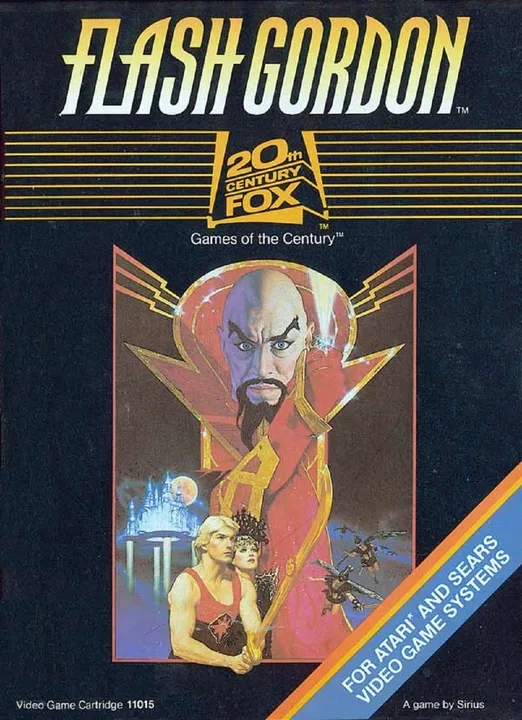
Flash Gordon
Many dedicated Spacemen have entered Spider City but none has ever been heard from again. It is up to you, Flash Gordon, to rescue any surviving Spacemen and to conquer this hideous city of tunnels. Spider City is conquered when all of its Hatching Pods are eliminated. It doesn't hurt to blast a few Generators or enemy Patrol Ships while you're there.
SCREENSHOTS
PHYSICAL
HISTORY
Flash Gordon is the protagonist of an American space adventure comic strip created and originally drawn by Alex Raymond. First published January 7, 1934, the strip was inspired by, and created to compete with, the already established Buck Rogers adventure strip.
Creation
The Buck Rogers comic strip had been commercially very successful, spawning novelizations and children's toys; King Features Syndicate decided to create its own science-fiction comic strip to compete with it. At first, King Features tried to purchase the rights to the John Carter of Mars stories by Edgar Rice Burroughs, but the syndicate was unable to reach an agreement with Burroughs. King Features then turned to Alex Raymond, one of their staff artists, to create the story.
One source for Flash Gordon was the Philip Wylie novel When Worlds Collide (1933). The book's themes of an approaching planet threatening the Earth, and an athletic hero, his girlfriend, and a scientist traveling to the new planet by rocket, were adapted by Raymond for the comic strip's initial storyline. Raymond's first samples were dismissed for not containing enough action sequences. Raymond reworked the story and sent it back to the syndicate, which accepted it. Raymond was partnered with ghostwriter Don W. Moore, an experienced editor and writer. Raymond's first Flash Gordon story appeared in January 1934, alongside Jungle Jim. The Flash Gordon strip was well received by newspaper readers, becoming one of the most popular American comic strips of the 1930s.
As with Buck Rogers, the success of Flash Gordon resulted in numerous licensed products being sold, including pop-up books, coloring books, and toy spaceships and rayguns.
Comic strip characters and story
The Flash Gordon comic strip ran as a Sunday strip from 1934 until 2003, and daily strip from 1940 to 1944 and 1951 to 1992. Reprints of the Sunday strip were syndicated by King Features Syndicate from 2003 until 2023, when Flash Gordon was relaunched with a new daily and Sunday strip.
The comic strip follows the adventures of Flash Gordon, a handsome polo player and Yale University graduate, and his companions Dale Arden and Dr. Hans Zarkov. The story begins with Earth threatened by a collision with the planet Mongo. Dr. Zarkov invents a rocket ship to fly into space in an attempt to stop the disaster. Half mad, he kidnaps Flash and Dale. Landing on the planet, and halting the collision, they come into conflict with Ming the Merciless, Mongo's evil ruler.
For many years, the three companions have adventures on Mongo, traveling to the forest kingdom of Arboria, ruled by Prince Barin; the ice kingdom of Frigia, ruled by Queen Fria; the jungle kingdom of Tropica, ruled by Queen Desira; the undersea kingdom of the Shark Men, ruled by King Kala; and the flying city of the Hawkmen, ruled by Prince Vultan. They are joined in several early adventures by Prince Thun of the Lion Men. Eventually, Ming is overthrown, and Mongo is ruled by a council of leaders led by Barin.
Flash and friends visit Earth for a series of adventures before returning to Mongo and crashing in the kingdom of Tropica, later reuniting with Barin and others. Flash and his friends then travel to other worlds before returning once again to Mongo, where Barin, now married to Ming's daughter Princess Aura, has established a peaceful rule (except for frequent revolts led by Ming or by one of his many descendants).
In the 1950s, Flash became an astronaut who traveled to other planets besides Mongo. The long story of the Skorpi War takes Flash to other star systems, using starships that are faster than light.
In addition to Ming and his allies, Flash and his friends also fought several other villains, including Azura, the Witch Queen; Brukka, chieftain of the giants of Frigia; the fascistic Red Sword organisation on Earth; and Brazor, the tyrannical usurper of Tropica. After Raymond's tenure, later writers created new enemies for Flash to combat. Austin Briggs created Kang the Cruel, Ming's callous son. Prince Polon, who had the power to shrink or enlarge living creatures, the unscrupulous Queen Rubia, and Pyron the Comet Master were among the antagonists introduced during Mac Raboy's run. The Skorpi, a race of alien shape shifters who desired to conquer the galaxy, were recurring villains in both the Mac Raboy and Dan Barry stories. The Skorpi space-fighter ace Baron Dak-Tula became a periodic nemesis of Flash in the late 1970s stories.
International versions of the comic strip
King Features sold the Flash Gordon strip to newspapers across the world, and by the late 1930s, the strip was published in 130 newspapers, translated into eight foreign languages, and was read by 50 million people. In the 1930s and 1940s, several newspapers in Britain carried Flash Gordon, including the Scottish Sunday Mail. In France, his adventures were published in the magazine Robinson, under the name "Guy l'Éclair". Dale Arden was named Camille in the French translation. In Australia, the character and strip were retitled Speed Gordon to avoid a negative connotation of the word "Flash". (At the time, the predominant meaning of "flashy" was "showy", connoting dishonesty.)
However, events in the 1930s affected the strip's distribution. Newspapers in Nazi Germany were forbidden to carry the Flash Gordon strip, while in Fascist Italy it was restricted to two newspapers. In 1938, the Spanish magazine Aventurero, the only publication in the country to carry Flash Gordon, ceased publication because of the Spanish Civil War. The outbreak of World War II resulted in Flash Gordon being discontinued in many countries. In Belgium, artist Edgar Pierre Jacobs was therefore asked to bring the current Flash Gordon story to a satisfactory conclusion, which he did.
After the war's end, the strip enjoyed a resurgence in international popularity. Flash Gordon reappeared in Italy, Spain, and West Germany, and it was also syndicated to new markets such as Portugal and the Irish Republic. From the 1950s onward, countries including Spain, Italy, and Denmark also reprinted Flash Gordon newspaper strips in comic-book or paperback-novel form. In India, Flash Gordon comics were published by Indrajal Comics.
Later years
The popularity of Raymond's Flash Gordon Sunday strip meant a daily strip was also introduced. This strip, drawn by Austin Briggs, ran from 1941 to 1944. After Raymond left Flash Gordon in 1944 to join the US Marines, the daily strip was cancelled and Briggs took over the Sunday strip. Although Raymond wanted to return to drawing Flash Gordon after the war's end, King Features did not want to remove Briggs from his position. To conciliate Raymond, King Features allowed him to create a new strip, Rip Kirby. After Briggs left the Sunday strip in 1948, he was succeeded by former comic-book artist Mac Raboy, who drew the strip until his death in 1967. In 1951, King Features created a new daily Flash Gordon strip, drawn by Dan Barry, who was assisted during his tenure by Harvey Kurtzman and Harry Harrison, who both wrote scripts for the strip. Barry also had several artists who aided him with Flash Gordon's illustrations, including Frank Frazetta, Al Williamson, Bob Fujitani, Jack Davis, Sy Barry, Fred Kida, and Emil Gershwin. When Barry left the strip in 1990, various artists and writers worked on Flash Gordon. The daily strip was ended in 1993. The final artist to work on the Flash Gordon Sunday strip was Jim Keefe, who was occasionally assisted on the strip by other artists, including Williamson, John Romita Sr., and Joe Kubert. King Features ended the Flash Gordon newspaper strip in 2003, although reruns of Keefe's strip still appear in a few US newspapers.
On October 20, 2023, King Features Syndicate announced it would relaunch Flash Gordon on October 22 under cartoonist Dan Schkade, and would be released daily, with the Sunday strip being an overview of the week's strips.
Strip bibliography
Don W. Moore wrote the strip during Raymond's tenure. Writers involved with Barry's daily run include Harvey Kurtzman from 1952 to 1953 and Harry Harrison from 1958 to 1964. Bruce Jones wrote during Reese and Morrow's tenure. Under Kalcik, writers included Richard Bruning, Kevin VanHook, and Thomas Warkentin.
Guido Fantoni drew an unofficial Flash Gordon comic strip in Italy's L'Avventuroso in 1938. Edgar P. Jacobs published a similarly unofficial strip in Belgium's Bravo in 1941.…
1CC RUNS
One-credit clears we point to as the benchmark for this game.
GAMEPLAY VIDEO
RELEASES 3 systems
PHYSICAL RELEASES 1 box
