
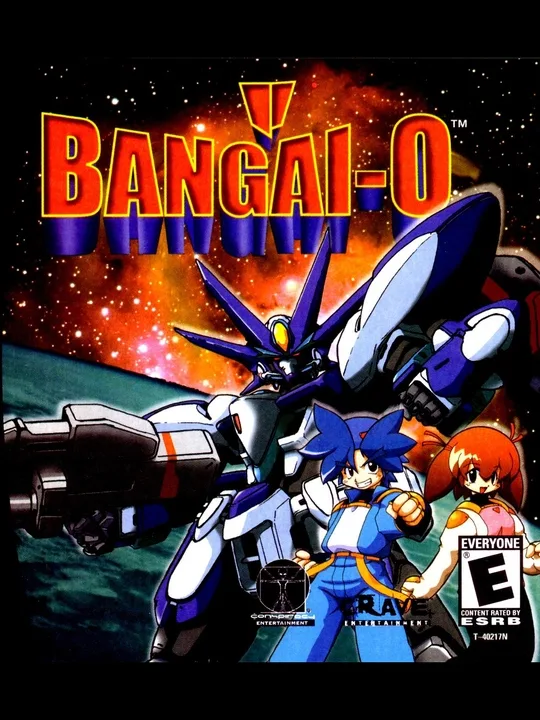
Bangai-O
In Bakuretsu Muteki Bangai-O, a multi-directional shooter video game developed by Treasure, two young mech-pilots, Riki and his sister Mami share command of the powerful humanoid-shaped Bangai-O and battle villains from the "Cosmo Gang", guilty of fruit contraband, and lots of gun turrets, bombs and robots through 44 levels.
SCREENSHOTS
PHYSICAL
HISTORY
Bangai-O is a multidirectional shooter developed by Treasure and released in 1999 on the Nintendo 64 in Japan. It was ported to the Dreamcast worldwide shortly after with some gameplay changes and updated graphics and audio. The game places the player in control of a weaponized mech that can hover across large stages and fire at enemies all around them. The player must reach the end of each stage and defeat the boss, while avoiding hazards scattered across the map such as enemy mechs and gun turrets.
The initial ideas for Bangai-O came from Treasure programmer Mitsuru Yaida who wanted to challenge himself by programming an extreme number of bullets on the screen at once. Journalists agree that Yaida was most likely inspired by the 1984 Japanese computer game Hover Attack. The team developed the game with a focus on creating enjoyable gameplay, and opted for simple graphical effects to preserve the game's speed. Bangai-O was released on the Nintendo 64 and was limited to a run of 10,000 copies because of publisher Entertainment Software Publishing's belief it had niche appeal. The team replaced most of the graphics and audio, changed some gameplay elements, and re-released it on the Dreamcast three months later, a version later released internationally.
Bangai-O received positive reviews from game journalists. Many critics compared it to shoot 'em ups and action games of the past, praising its retro gameplay and aesthetics. They also commended the level design for keeping the game interesting throughout. Some reviews, especially those for the Dreamcast version, were more critical of the graphics and believed the game's value was primarily in its nostalgic gameplay. The game received two sequels: Bangai-O Spirits (2008) for the Nintendo DS and Bangai-O HD: Missile Fury (2011) for the Xbox 360.
Gameplay
Bangai-O is a 2D side-scrolling multidirectional shooter. The player controls a weaponized mech that is piloted by the two main characters, Riki and his sister Mami. The story follows Riki and Mami in their efforts to stop criminals from smuggling fruit contraband to finance their evil deeds. The player can fly freely around each of the game's 44 stages, and must find and destroy the boss in each stage to advance. The mech can shoot in eight directions, and the type of ammo is dependent on which character is piloting. The two pilots can be interchanged instantaneously, Riki fires homing missiles and Mami shoots reflecting projectiles which bounce off walls. The stages are populated with destroyable buildings and obstacles, as well as some walls that are opened by switches. There are also hazards such as gun turrets and enemy mechs which fire projectiles at the player. The player has a health meter but no brief invulnerability period after being hit, so can die instantly if hit with a barrage of fire. Destroyed enemies and objects yield fruit which replenishes a meter that is used to power the "scatter bomb" attack. This attack can be charged to release up to 100 shots scattered in all directions at once. Hitting all 100 shots on enemies will open a small portal to a shop where the player can get upgrades such as improved shot damage.
The Dreamcast version of Bangai-O, released after the initial Nintendo 64 version, features significant differences in gameplay which results in a more streamlined experience. In the Dreamcast version, the bullets are stronger, and destroying objects and enemies refills the bomb attack meter instead of fruit which now only add to the player's score. The bomb attack also can no longer be charged to a specific number of missiles, but is dependent on the player's proximity to enemy projectiles. In the Dreamcast version, up to 400 missiles can be shot at once in comparison to 100 on the Nintendo 64. Also, the shop is removed. Instead, the game includes power-ups that can be found among environment wreckage. There are also other minor differences such as scoring differences and more structure and enemy types.
Development
The idea for Bangai-O came from Treasure employee Mitsuru Yaida (commonly known by the pseudonym "Yaiman"). He remembered playing an older shooting game that amazed him with the sheer number of bullets that could be rendered on the screen at once. Even though Yaiman and other staff behind the game have not identified the game, industry analysts agree that the game is almost certainly Hover Attack (1984) for Japanese computers. Yaiman began thinking about the programming challenges involved in detecting when the bullets collide with other objects, and started work on a prototype. He later received permission from company president Masato Maegawa to pull in other staff and work towards producing a full game. Yaiman served as the main programmer and "General Manager". About ten people worked on Bangai-O.
Treasure developed the game with a focus on creating addictive and fast gameplay, with less focus on graphics. They opted for large and fast 2D graphical effects and anime artwork to preserve their style. One of the artists on the team, Koichi Kimura, had just finished working on Guardian Heroes (1996), another 2D game. With more powerful development hardware available, he wanted to challenge himself the possibilities and limits of 2D graphics. The story is based on typical Japanese yakuza revenge plays.
Release
Treasure announced Bangai-O for the Nintendo 64 in June 1999. It was released on September 3 the same year. Because of the game's niche appeal, the publisher Entertainment Software Publishing (ESP) only shipped 10,000 units.
The Dreamcast version was first released in Japan on December 9, 1999. This version had improved graphics and audio over the Nintendo 64 original. Many of the sprites were reworked, background animations were added, and the game now featured CD-quality music. By February 2000, publishers were researching the possibility of localizing the Dreamcast version for Western audiences. At the Electronic Entertainment Expo (E3) in May that year, it was reported that German publisher Swing! Entertainment had secured the rights to localize and market the game in Europe and North America. It would rename the title as Bangai-O from its obscure Japanese title, Bakuretsu Muteki Bangaioh, and announced that it would be released in the third quarter of 2000. IGN would later report at E3 that a publisher named Classified Games would publish the game in North America. In December, industry newcomer Conspiracy Entertainment announced they were localizing Bangai-O along with another Dreamcast game, Record of Lodoss War (2000). The Dreamcast version was planned for release on February 27, 2001, but was eventually released on March 21.
== Reception ==…
GAMEPLAY VIDEO
SCORES
ACHIEVEMENTS 1 set
Tracked by RetroAchievements and earned in an emulator that reports to it. A game tracked on more than one machine gets a set for each, because they are different lists earned on different hardware.
RELEASES 2 systems
PHYSICAL RELEASES 1 box
